Pearson+ LogoPearson+ Logo
Ch. 3 - Cell Division and Chromosome Heredity
Sanders - Genetic Analysis: An Integrated Approach 3rd Edition
Sanders3rd EditionGenetic Analysis: An Integrated ApproachISBN: 9780135564172Not the one you use?Change textbook
Chapter 3, Problem 8

Suppose crossover occurs between the homologous chromosomes in the previous problem. At what stage of M phase do alleles D and d segregate?

Verified step by step guidance
1
Understand the context: The problem involves the segregation of alleles D and d during meiosis. Meiosis is a specialized cell division process that reduces the chromosome number by half and involves two stages: Meiosis I and Meiosis II.
Recall the principle of segregation: Alleles segregate during meiosis when homologous chromosomes are separated. This occurs during Anaphase I of Meiosis I, where homologous chromosomes (each carrying one allele) are pulled to opposite poles of the cell.
Consider the role of crossover: Crossover occurs during Prophase I of Meiosis I, where homologous chromosomes exchange genetic material. This does not affect the segregation of alleles D and d, as segregation is determined by the separation of homologous chromosomes.
Identify the specific stage: The alleles D and d segregate during Anaphase I of Meiosis I, as this is when homologous chromosomes (each carrying one allele) are separated and move to opposite poles.
Conclude the reasoning: The segregation of alleles D and d is a direct result of the separation of homologous chromosomes during Anaphase I, regardless of whether crossover has occurred earlier in Prophase I.

Verified video answer for a similar problem:

This video solution was recommended by our tutors as helpful for the problem above.
Video duration:
3m
Was this helpful?

Key Concepts

Here are the essential concepts you must grasp in order to answer the question correctly.

Crossover

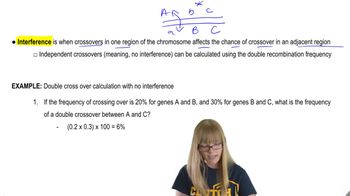
Crossover is a genetic process that occurs during prophase I of meiosis, where homologous chromosomes exchange segments of genetic material. This exchange increases genetic diversity in gametes by creating new allele combinations. Understanding crossover is essential for analyzing how alleles are inherited and how they can segregate during meiosis.
Recommended video:
Guided course
06:14
Multiple Cross Overs and Interference

Meiosis

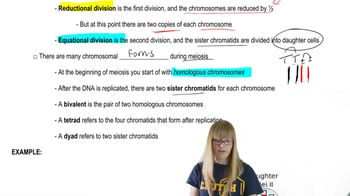
Meiosis is a specialized type of cell division that reduces the chromosome number by half, resulting in four genetically diverse gametes. It consists of two sequential divisions: meiosis I and meiosis II. The segregation of alleles occurs during these divisions, particularly during anaphase I when homologous chromosomes are pulled apart.
Recommended video:
Guided course
05:30
Meiosis Overview

Segregation of Alleles

The segregation of alleles refers to the separation of different alleles of a gene during gamete formation. According to Mendel's law of segregation, alleles for a trait segregate independently into gametes during meiosis. In the context of the question, alleles D and d segregate during anaphase I of meiosis when homologous chromosomes are separated.
Recommended video:
Guided course
03:03
New Alleles and Migration