Pearson+ LogoPearson+ Logo
Ch. 3 - Cell Division and Chromosome Heredity
Sanders - Genetic Analysis: An Integrated Approach 3rd Edition
Sanders3rd EditionGenetic Analysis: An Integrated ApproachISBN: 9780135564172Not the one you use?Change textbook
Chapter 3, Problem 35

Red–green color blindness is a relatively common condition found in about 8% of males in the general population. From this, population, biologists estimate that 8% is the frequency of X chromosomes carrying a mutation of the gene encoding red and green color vision. Based on this frequency, determine the approximate frequency with which you would expect females to have red–green color blindness. Explain your reasoning.

Verified step by step guidance
1
Understand that red-green color blindness is an X-linked recessive trait. This means that males (XY) need only one mutated X chromosome to express the condition, while females (XX) need two mutated X chromosomes to express the condition.
The frequency of X chromosomes carrying the mutation is given as 8% (0.08). For females to have red-green color blindness, they must inherit two mutated X chromosomes, one from each parent.
To calculate the frequency of females with red-green color blindness, use the Hardy-Weinberg principle. The probability of a female inheriting two mutated X chromosomes is the square of the frequency of the mutated X chromosome: \( q^2 \), where \( q \) is the frequency of the mutated X chromosome.
Substitute the given frequency of the mutated X chromosome (\( q = 0.08 \)) into the formula \( q^2 \). This represents the proportion of females who are homozygous for the mutation and thus have red-green color blindness.
Conclude that the calculated value of \( q^2 \) represents the expected frequency of females with red-green color blindness in the population. This value is much lower than the 8% observed in males because females require two copies of the mutation to express the condition.

Verified video answer for a similar problem:

This video solution was recommended by our tutors as helpful for the problem above.
Video duration:
4m
Was this helpful?

Key Concepts

Here are the essential concepts you must grasp in order to answer the question correctly.

X-Linked Inheritance

Red-green color blindness is an X-linked recessive trait, meaning the gene responsible for this condition is located on the X chromosome. Males, having one X and one Y chromosome, express the trait if their single X carries the mutation. In contrast, females have two X chromosomes, so they must inherit two copies of the mutated gene to express the condition.
Recommended video:
Guided course
09:30
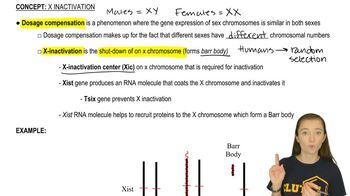
X-Inactivation

Hardy-Weinberg Principle

The Hardy-Weinberg principle provides a mathematical framework for understanding allele frequencies in a population at equilibrium. It allows biologists to estimate the frequency of genotypes based on known allele frequencies. In this case, knowing that 8% of males are affected helps calculate the expected frequency of affected females using the principle.
Recommended video:
Guided course
13:04
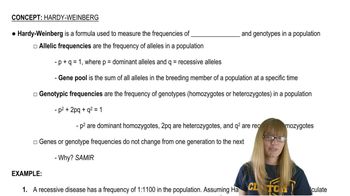
Hardy Weinberg

Genotype Frequency Calculation

To determine the frequency of red-green color blindness in females, we can use the allele frequency of the mutated X chromosome. If 8% of males are affected, this indicates that the frequency of the mutated allele (X^c) is 0.08. For females, the frequency of homozygous recessive individuals (X^cX^c) can be calculated as (0.08)^2, leading to an expected frequency of approximately 0.0064 or 0.64%.
Recommended video:
Guided course
07:04
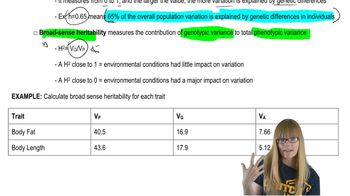
Calculating Heritability
Related Practice
Textbook Question

Form a small discussion group and decide on the most likely genetic explanation for each of the following situations;

A man who has red–green color blindness and a woman who has complete color vision have a son with red–green color blindness. What are the genotypes of these three people, and how do you explain the color blindness of the son?

Textbook Question

Form a small discussion group and decide on the most likely genetic explanation for each of the following situations;

Cross A, performed by Morgan and shown in the figure below, is between a mutant male fruit fly with white eyes and a female fruit fly from a pure-breeding, red-eye stock. The figure shows that 1237 F1 progeny were produced, all of them with red eyes. In reality, this isn't entirely true. Among the 1237 F1 progeny were 3 male flies with white eyes. Give two possible explanations for the appearance of these white-eyed males.

Textbook Question

Duchenne muscular dystrophy (DMD; OMIM 310200) and Becker muscular dystrophy (BMD; OMIM 300376) are both X-linked recessive conditions that result from different mutations of the same gene, known as dystrophin, on the long arm of the chromosome. BMD and DMD are quite different clinically. DMD is a very severe disorder that first appears at a young age, progresses rapidly, and is often fatal in the late teens to 20s. BMD, on the other hand, is much milder. Often symptoms don't first appear until the 40s or 50s, the progression of the disease is slow, and fatalities due to BMD are infrequent. Go to https://www.ncbi.nlm.nih/omim and survey the information describing the gene mutations causing these two conditions. Discuss the information you find with a few others in a small group, and write a single summary explaining your findings.