Pearson+ LogoPearson+ Logo
Ch. 3 - Cell Division and Chromosome Heredity
Sanders - Genetic Analysis: An Integrated Approach 3rd Edition
Sanders3rd EditionGenetic Analysis: An Integrated ApproachISBN: 9780135564172Not the one you use?Change textbook
Chapter 3, Problem 1

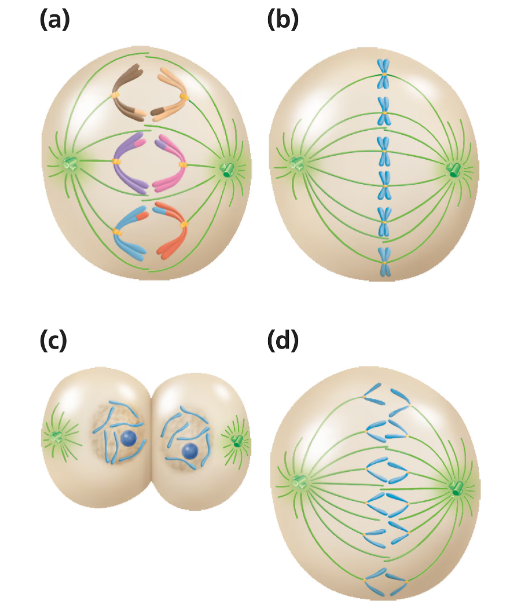
Examine the following diagrams of cells from an organism with diploid number 2n=6, and identify what stage of M phase is represented.

Verified step by step guidance
1
Step 1: Understand the diploid number 2n=6 means the organism has 6 chromosomes arranged in 3 homologous pairs. Each chromosome consists of two sister chromatids during M phase.
Step 2: Identify the key features of each stage of mitosis: (a) chromosomes aligned at the metaphase plate (metaphase), (b) chromosomes condensed but not yet aligned (prometaphase), (c) two daughter cells forming with separated chromosomes (telophase/cytokinesis), (d) chromosomes being pulled apart toward opposite poles (anaphase).
Step 3: Analyze image (a): chromosomes are aligned in the center of the cell, attached to spindle fibers from opposite poles, indicating metaphase.
Step 4: Analyze image (b): chromosomes are condensed and spindle fibers are attached, but chromosomes are not yet aligned at the center, indicating prometaphase.
Step 5: Analyze image (c): two cells are forming with nuclei reappearing, indicating telophase and cytokinesis, and image (d): sister chromatids are being pulled apart toward opposite poles, indicating anaphase.

Verified video answer for a similar problem:

This video solution was recommended by our tutors as helpful for the problem above.
Video duration:
58s
Was this helpful?

Key Concepts

Here are the essential concepts you must grasp in order to answer the question correctly.

Stages of Mitosis

Mitosis is the process of nuclear division in eukaryotic cells, consisting of prophase, metaphase, anaphase, and telophase. Each stage is characterized by specific chromosome arrangements and spindle fiber behaviors, which are critical for accurate chromosome segregation.
Recommended video:
Guided course
09:46
Mitosis Steps

Chromosome Behavior During Mitosis

During mitosis, chromosomes condense and become visible. In metaphase, chromosomes align at the cell's equatorial plate; in anaphase, sister chromatids separate and move to opposite poles; in telophase, chromatids arrive at poles and begin to decondense, signaling the end of nuclear division.
Recommended video:
Guided course
09:46
Mitosis Steps

Role of Spindle Fibers and Centrosomes

Spindle fibers, originating from centrosomes (microtubule organizing centers), attach to chromosomes at kinetochores and facilitate their movement. The organization and dynamics of spindle fibers are essential for proper chromosome alignment and segregation during mitosis.
Recommended video:
Guided course
07:10
Chromosome Structure