
Textbook Question
Our closest primate relative, the chimpanzee, has a diploid number of 2n = 48. For each of the following stages of M phase, identify the number of chromosomes present in each cell.
Meiotic metaphase I


 Verified step by step guidance
 27:36
27:36
 04:29
04:29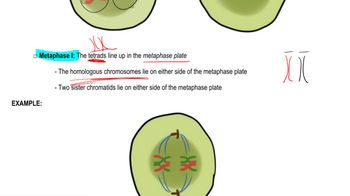 09:06
09:06Our closest primate relative, the chimpanzee, has a diploid number of 2n = 48. For each of the following stages of M phase, identify the number of chromosomes present in each cell.
Meiotic metaphase I
Our closest primate relative, the chimpanzee, has a diploid number of 2n = 48. For each of the following stages of M phase, identify the number of chromosomes present in each cell.
End of meiotic anaphase II
Our closest primate relative, the chimpanzee, has a diploid number of 2n = 48. For each of the following stages of M phase, identify the number of chromosomes present in each cell.
Early mitotic prophase
Our closest primate relative, the chimpanzee, has a diploid number of 2n = 48. For each of the following stages of M phase, identify the number of chromosomes present in each cell.
Early prophase I
In a test of his chromosome theory of heredity, Morgan crossed a female Drosophila with red eyes to a male with white eyes. The females were produced from Cross A, shown in the Figure below. Predict the offspring Morgan would have expected under his hypothesis that the gene for eye color is on the X chromosome in fruit flies.
For the retinal cancer retinoblastoma, the inheritance of one mutated copy of RB1 from one of the parents is often referred to as a mutation that produces a 'dominant predisposition to cancer.' This means that the first mutation does not produce cancer but makes it very likely that cancer will develop.
Using RB1⁺ for the normal wild-type allele and RB1⁻ for the mutant allele, identify the genotype of a cell in a retinoblastoma tumor.