Pearson+ LogoPearson+ Logo
Ch. 3 - Cell Division and Chromosome Heredity
Sanders - Genetic Analysis: An Integrated Approach 3rd Edition
Sanders3rd EditionGenetic Analysis: An Integrated ApproachISBN: 9780135564172Not the one you use?Change textbook
Chapter 3, Problem 24a

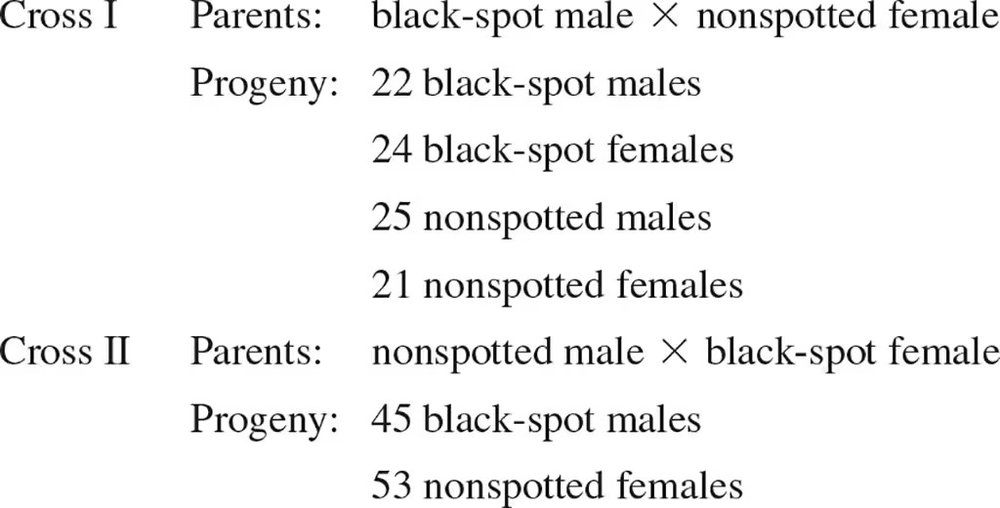
In a species of fish, a black spot on the dorsal fin is observed in males and females. A fish breeder carries out a pair of reciprocal crosses and observes the following results.
  Data from reciprocal crosses of fish showing inheritance patterns of black spots on dorsal fins.
Why does this evidence support the hypothesis that a black spot is sex linked?

Verified step by step guidance
1
Step 1: Understand the concept of sex-linked inheritance. Traits that are sex-linked are typically associated with genes located on the sex chromosomes (X or Y). In many species, males are XY and females are XX, meaning that inheritance patterns can differ between sexes.
Step 2: Analyze the results of Cross I. In this cross, a black-spot male (XY) is crossed with a nonspotted female (XX). The progeny includes both black-spot and nonspotted males and females in roughly equal proportions. This suggests that the black-spot trait is not autosomal (not inherited equally regardless of sex) but may be linked to the sex chromosomes.
Step 3: Analyze the results of Cross II. In this cross, a nonspotted male (XY) is crossed with a black-spot female (XX). The progeny includes only black-spot males and nonspotted females. This pattern is consistent with X-linked inheritance, where the black-spot allele is carried on the X chromosome.
Step 4: Consider the inheritance mechanism. In X-linked inheritance, males inherit their single X chromosome from their mother and their Y chromosome from their father. Females inherit one X chromosome from each parent. The results of Cross II suggest that the black-spot allele is dominant and located on the X chromosome, as all males inherit the black-spot trait from their mother.
Step 5: Conclude why the evidence supports sex-linked inheritance. The differing patterns of inheritance between males and females in the two crosses, along with the observation that males inherit the black-spot trait only from their mother, strongly support the hypothesis that the black-spot trait is X-linked.

Verified video answer for a similar problem:

This video solution was recommended by our tutors as helpful for the problem above.
Video duration:
2m
Was this helpful?

Key Concepts

Here are the essential concepts you must grasp in order to answer the question correctly.

Sex Linkage

Sex linkage refers to the association of a gene with a sex chromosome. In many species, certain traits are inherited differently in males and females due to the presence of these genes on the X or Y chromosomes. If a trait is sex-linked, it often shows different inheritance patterns based on the sex of the offspring, which can be observed in the progeny ratios from genetic crosses.
Recommended video:
Guided course
07:33
Chi Square and Linkage

Reciprocal Crosses

Reciprocal crosses involve mating two organisms in both possible combinations to determine the inheritance patterns of traits. By switching the sexes of the parents in the crosses, researchers can identify whether a trait is influenced by sex-linked genes or autosomal genes. The results from these crosses can reveal differences in trait expression based on the sex of the parent contributing the trait.
Recommended video:
Guided course
26:08
Trihybrid Cross

Progeny Ratios

Progeny ratios are the expected or observed frequencies of different phenotypes or genotypes in the offspring resulting from a genetic cross. Analyzing these ratios helps determine the inheritance pattern of traits. In this case, the differing ratios of black-spot and nonspotted fish in the progeny suggest a sex-linked inheritance, as the distribution varies significantly between the two crosses.
Recommended video:
Guided course
05:13
Organelle Inheritance
Related Practice
Textbook Question

Use the blank pedigrees provided to depict transmission of

(a) an X-linked recessive trait and

(b) an X-linked dominant trait, by filling in circles and squares to represent individuals with the trait of interest. Give genotypes for each person in each pedigree.

Carefully design each transmission pattern so that pedigree

(a) cannot be confused with autosomal recessive transmission and pedigree

(b) cannot be confused with autosomal dominant transmission. Identify the transmission events that eliminate the possibility of autosomal transmission for each pedigree.

5
views
Textbook Question

The following figure illustrates reciprocal crosses involving chickens with sex-linked dominant barred mutation. For Cross A and for Cross B, cross the F₁ roosters and hens and predict the feather patterns of roosters and hens in the F2.

3
views
Textbook Question

In fruit flies, yellow body (y) is recessive to gray body , and the trait of body color is inherited on the X chromosome. Vestigial wing (v) is recessive to full-sized wing (v⁺), and the trait has autosomal inheritance. A cross of a male with yellow body and full wings to a female with gray body and full wings is made. Based on an analysis of the progeny of the cross shown below, determine the genotypes of parental and progeny flies.

[Table below appears at this point containing crosses and results]

Textbook Question

In a species of fish, a black spot on the dorsal fin is observed in males and females. A fish breeder carries out a pair of reciprocal crosses and observes the following results.

Identify which sex is heterogametic. Give genotypes for the parents in each cross, and explain the progeny proportions in each cross.

Textbook Question

Lesch–Nyhan syndrome (OMIM 300322) is a rare X-linked recessive disorder that produces severe mental retardation, spastic cerebral palsy, and self-mutilation.


What is the probability that the first son of a woman whose brother has Lesch–Nyhan syndrome will be affected?

Textbook Question

Lesch–Nyhan syndrome (OMIM 300322) is a rare X-linked recessive disorder that produces severe mental retardation, spastic cerebral palsy, and self-mutilation.


If the first son of the woman described in (a) is affected, what is the probability that her second son is affected?

2
views