Pearson+ LogoPearson+ Logo
Ch. 3 - Cell Division and Chromosome Heredity
Sanders - Genetic Analysis: An Integrated Approach 3rd Edition
Sanders3rd EditionGenetic Analysis: An Integrated ApproachISBN: 9780135564172Not the one you use?Change textbook
Chapter 3, Problem 16

In a large metropolitan hospital, cells from newborn babies are collected and examined microscopically over a 5-year period. Among approximately 7500 newborn males, six have one Barr body in the nuclei of their somatic cells. All other newborn males have no Barr bodies. Among 7500 female infants, four have two Barr bodies in each nucleus, two have no Barr bodies, and the rest have one. What is the cause of the unusual number of Barr bodies in a small number of male and female infants?

Verified step by step guidance
1
Step 1: Understand the concept of Barr bodies. Barr bodies are inactivated X chromosomes found in the nuclei of somatic cells. Normally, males (XY) have no Barr bodies, while females (XX) have one Barr body per cell. The number of Barr bodies is equal to the number of X chromosomes minus one.
Step 2: Analyze the data for males. Among 7500 newborn males, six have one Barr body. This suggests that these males have an extra X chromosome (XXY), which is indicative of Klinefelter syndrome.
Step 3: Analyze the data for females. Among 7500 newborn females, four have two Barr bodies, which suggests they have three X chromosomes (XXX). This condition is known as Triple X syndrome. Additionally, two females have no Barr bodies, which indicates they have only one X chromosome (XO), a condition known as Turner syndrome.
Step 4: Relate the findings to chromosomal abnormalities. The unusual number of Barr bodies in these infants is caused by variations in the number of sex chromosomes, which result from nondisjunction during meiosis. Nondisjunction is the failure of chromosomes to separate properly during gamete formation.
Step 5: Conclude that the presence of abnormal numbers of Barr bodies in these infants is a direct result of chromosomal aneuploidy, specifically conditions like Klinefelter syndrome (XXY), Triple X syndrome (XXX), and Turner syndrome (XO). These conditions arise due to errors in chromosome segregation during parental gamete formation.

Verified video answer for a similar problem:

This video solution was recommended by our tutors as helpful for the problem above.
Video duration:
1m
Was this helpful?

Key Concepts

Here are the essential concepts you must grasp in order to answer the question correctly.

Barr Bodies

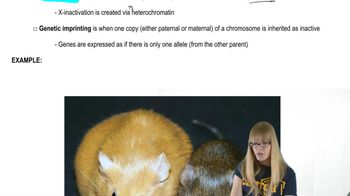
Barr bodies are inactivated X chromosomes found in the nuclei of female cells. In typical females, one X chromosome is active while the other is condensed into a Barr body. This process, known as X-inactivation, ensures dosage compensation between males (XY) and females (XX) in terms of X-linked gene expression.
Recommended video:
Guided course
02:51
Other Chromatin Modifications

Klinefelter Syndrome

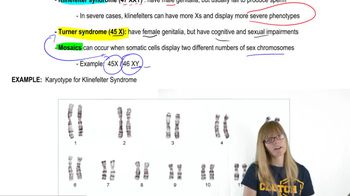
Klinefelter syndrome is a genetic condition in males characterized by the presence of an extra X chromosome, resulting in a 47,XXY karyotype. Males with this condition typically have one Barr body due to the inactivation of one of the X chromosomes. This syndrome can lead to various physical and developmental traits, including infertility and reduced testosterone levels.
Recommended video:
Guided course
10:35
Human Sex Chromosomes

Turner Syndrome

Turner syndrome occurs in females who have a missing or incomplete X chromosome, typically resulting in a 45,X karyotype. In some cases, females with Turner syndrome may have no Barr bodies if they have only one X chromosome. However, variations can occur, leading to the presence of one or more Barr bodies in individuals with atypical chromosomal patterns, such as mosaicism.
Recommended video:
Guided course
10:35
Human Sex Chromosomes
Related Practice
Textbook Question

A wild-type male and a wild-type female Drosophila with red eyes and full wings are crossed. Their progeny are shown below.

Using clearly defined allele symbols of your choice, give the genotype of each parent.

Textbook Question

A wild-type male and a wild-type female Drosophila with red eyes and full wings are crossed. Their progeny are shown below.

What is/are the genotype(s) of females with purple eye? Of males with purple eye and miniature wing?

Textbook Question

A woman with severe discoloration of her tooth enamel has four children with a man who has normal tooth enamel. Two of the children, a boy (B) and a girl (G), have discolored enamel. Each has a mate with normal tooth enamel and produces several children. G has six children—four boys and two girls. Two of her boys and one of her girls have discolored enamel. B has seven children—four girls and three boys. All four of his daughters have discolored enamel, but all his boys have normal enamel. Explain the inheritance of this condition.

Textbook Question

In cats, tortoiseshell coat color appears in females. A tortoiseshell coat has patches of dark brown fur and patches of orange fur that each in total cover about half the body but have a unique pattern in each female. Male cats can be either dark brown or orange, but a male cat with tortoiseshell coat is rarely produced. Two sample crosses between males and females from pure-breeding lines produced the tortoiseshell females shown.


Cross I     P: dark brown male × orange female

           F₁: orange males and tortoiseshell females

Cross II    P: orange male × dark brown female

          F₁: dark brown males and tortoiseshell females


Explain the inheritance of dark brown, orange, and tortoiseshell coat colors in cats.

Textbook Question

In cats, tortoiseshell coat color appears in females. A tortoiseshell coat has patches of dark brown fur and patches of orange fur that each in total cover about half the body but have a unique pattern in each female. Male cats can be either dark brown or orange, but a male cat with tortoiseshell coat is rarely produced. Two sample crosses between males and females from pure-breeding lines produced the tortoiseshell females shown.


Cross I     P: dark brown male × orange female

           F₁: orange males and tortoiseshell females

Cross II    P: orange male × dark brown female

           F₁: dark brown males and tortoiseshell females


Why are tortoiseshell cats female?

Textbook Question

In cats, tortoiseshell coat color appears in females. A tortoiseshell coat has patches of dark brown fur and patches of orange fur that each in total cover about half the body but have a unique pattern in each female. Male cats can be either dark brown or orange, but a male cat with tortoiseshell coat is rarely produced. Two sample crosses between males and females from pure-breeding lines produced the tortoiseshell females shown.


Cross I     P: dark brown male × orange female

           F₁: orange males and tortoiseshell females

Cross II    P: orange male × dark brown female

           F₁: dark brown males and tortoiseshell females


The genetics service of a large veterinary hospital gets referrals for three or four male tortoiseshell cats every year. These cats are invariably sterile and have underdeveloped testes. How are these tortoiseshell male cats produced? Why do you think they are sterile?