Pearson+ LogoPearson+ Logo
Ch. 3 - Cell Division and Chromosome Heredity
Sanders - Genetic Analysis: An Integrated Approach 3rd Edition
Sanders3rd EditionGenetic Analysis: An Integrated ApproachISBN: 9780135564172Not the one you use?Change textbook
Chapter 3, Problem 14a

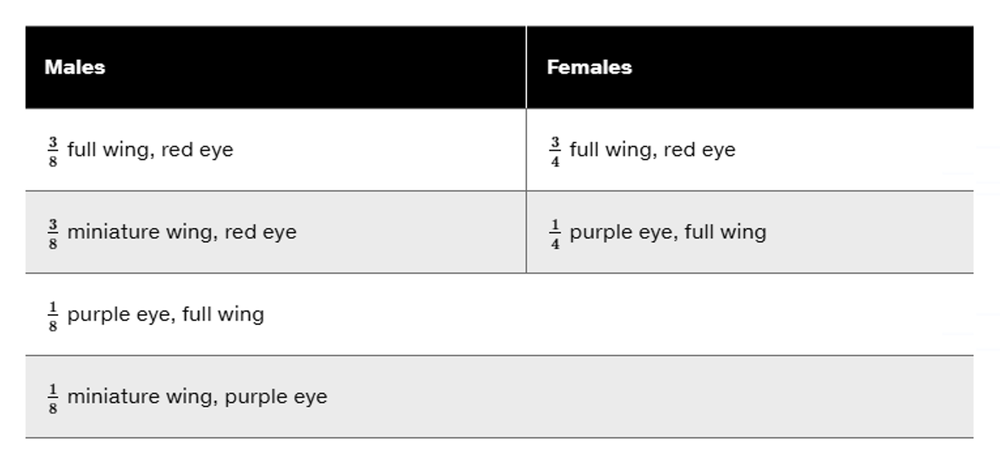
A wild-type male and a wild-type female Drosophila with red eyes and full wings are crossed. Their progeny are shown below.
Genetic cross results showing phenotypes of Drosophila progeny: wing and eye color variations in males and females.
Using clearly defined allele symbols of your choice, give the genotype of each parent.

Verified step by step guidance
1
Define allele symbols for the traits: Use 'R' for red eyes (dominant) and 'r' for purple eyes (recessive). For wing size, use 'F' for full wings (dominant) and 'f' for miniature wings (recessive).
Analyze the phenotypic ratios in the progeny: The male progeny show a 3:3:1:1 ratio for full wing/red eye, miniature wing/red eye, purple eye/full wing, and miniature wing/purple eye. The female progeny show a 3:1 ratio for full wing/red eye and purple eye/full wing.
Determine the inheritance pattern: The 3:1 ratio in females suggests that the eye color trait is X-linked, with red eyes (R) being dominant over purple eyes (r). The wing size trait appears to be autosomal, with full wings (F) dominant over miniature wings (f).
Assign genotypes to the parents: Since the male parent contributes the X chromosome to daughters and the Y chromosome to sons, and the female parent contributes one X chromosome to all offspring, deduce the parental genotypes based on the progeny ratios. The male parent must be X^R Y for eye color and Ff for wing size. The female parent must be X^R X^r for eye color and Ff for wing size.
Verify the parental genotypes: Cross the genotypes (X^R Y, Ff) for the male and (X^R X^r, Ff) for the female. Use a Punnett square to confirm that the progeny phenotypes match the observed ratios, ensuring the genotypes are correct.

Verified video answer for a similar problem:

This video solution was recommended by our tutors as helpful for the problem above.
Video duration:
1m
Was this helpful?

Key Concepts

Here are the essential concepts you must grasp in order to answer the question correctly.

Drosophila Genetics

Drosophila melanogaster, commonly known as fruit flies, are a model organism in genetics due to their simple genetic structure and short life cycle. They have well-defined traits, such as eye color and wing size, which are controlled by specific genes. Understanding the inheritance patterns of these traits is crucial for analyzing genetic crosses and predicting progeny outcomes.
Recommended video:
Guided course
09:03
Modern Genetics

Alleles and Genotypes

Alleles are different forms of a gene that can exist at a specific locus on a chromosome. In this context, the traits of eye color and wing size are determined by alleles, which can be dominant or recessive. The genotype refers to the specific combination of alleles an organism possesses, which influences its phenotype, or observable traits.
Recommended video:
Guided course
03:03
New Alleles and Migration

Punnett Squares and Mendelian Inheritance

Punnett squares are a tool used to predict the genotypic and phenotypic ratios of offspring from a genetic cross. Mendelian inheritance principles, including the law of segregation and independent assortment, guide these predictions. By analyzing the ratios of traits in the progeny, one can infer the genotypes of the parent organisms involved in the cross.
Recommended video:
Guided course
02:48
Chi Square Analysis
Related Practice
Textbook Question

In humans, hemophilia A (OMIM 306700) is an X-linked recessive disorder that affects the gene for factor VIII protein, which is essential for blood clotting. The dominant and recessive alleles for the factor VIII gene are represented by H and h. Albinism is an autosomal recessive condition that results from mutation of the gene producing tyrosinase, an enzyme in the melanin synthesis pathway. A and a represent the tyrosinase alleles. A healthy woman named Clara (II-2), whose father (I-1) has hemophilia and whose brother (II-1) has albinism, is married to a healthy man named Charles (II-3), whose parents are healthy. Charles's brother (II-5) has hemophilia, and his sister (II-4) has albinism. The pedigree is shown below.

What are the genotypes of the four parents (I-1 to I-4) in this pedigree?

Textbook Question

In humans, hemophilia A (OMIM 306700) is an X-linked recessive disorder that affects the gene for factor VIII protein, which is essential for blood clotting. The dominant and recessive alleles for the factor VIII gene are represented by H and h. Albinism is an autosomal recessive condition that results from mutation of the gene producing tyrosinase, an enzyme in the melanin synthesis pathway. A and a represent the tyrosinase alleles. A healthy woman named Clara (II-2), whose father (I-1) has hemophilia and whose brother (II-1) has albinism, is married to a healthy man named Charles (II-3), whose parents are healthy. Charles's brother (II-5) has hemophilia, and his sister (II-4) has albinism. The pedigree is shown below.

Determine the probability that the first child of Clara and Charles will be a


i. boy with hemophilia

ii. girl with albinism

iii. healthy girl

iv. boy with both albinism and hemophilia

v. boy with albinism

vi. girl with hemophilia

Textbook Question

In humans, hemophilia A (OMIM 306700) is an X-linked recessive disorder that affects the gene for factor VIII protein, which is essential for blood clotting. The dominant and recessive alleles for the factor VIII gene are represented by H and h. Albinism is an autosomal recessive condition that results from mutation of the gene producing tyrosinase, an enzyme in the melanin synthesis pathway. A and a represent the tyrosinase alleles. A healthy woman named Clara (II-2), whose father (I-1) has hemophilia and whose brother (II-1) has albinism, is married to a healthy man named Charles (II-3), whose parents are healthy. Charles's brother (II-5) has hemophilia, and his sister (II-4) has albinism. The pedigree is shown below.

If Clara and Charles's first child has albinism, what is the chance the second child has albinism? Explain why this probability is higher than the probability you calculated in part (b).

Textbook Question

A wild-type male and a wild-type female Drosophila with red eyes and full wings are crossed. Their progeny are shown below.

What is/are the genotype(s) of females with purple eye? Of males with purple eye and miniature wing?

Textbook Question

A woman with severe discoloration of her tooth enamel has four children with a man who has normal tooth enamel. Two of the children, a boy (B) and a girl (G), have discolored enamel. Each has a mate with normal tooth enamel and produces several children. G has six children—four boys and two girls. Two of her boys and one of her girls have discolored enamel. B has seven children—four girls and three boys. All four of his daughters have discolored enamel, but all his boys have normal enamel. Explain the inheritance of this condition.

Textbook Question

In a large metropolitan hospital, cells from newborn babies are collected and examined microscopically over a 5-year period. Among approximately 7500 newborn males, six have one Barr body in the nuclei of their somatic cells. All other newborn males have no Barr bodies. Among 7500 female infants, four have two Barr bodies in each nucleus, two have no Barr bodies, and the rest have one. What is the cause of the unusual number of Barr bodies in a small number of male and female infants?