Pearson+ LogoPearson+ Logo
Ch. 3 - Cell Division and Chromosome Heredity
Sanders - Genetic Analysis: An Integrated Approach 3rd Edition
Sanders3rd EditionGenetic Analysis: An Integrated ApproachISBN: 9780135564172Not the one you use?Change textbook
Chapter 3, Problem 30a

Drosophila has a diploid chromosome number of 2n = 8, which includes one pair of sex chromosomes (XX in females and XY in males) and three pairs of autosomes. Consider a Drosophila male that has a copy of the A₁ allele on its X chromosome (the Y chromosome is the homolog) and is heterozygous for alleles B₁ and B₂, C₁ and C₂, and D₁ and D₂ of genes that are each on a different autosomal pair. In the diagrams requested below, indicate the alleles carried on each chromosome and sister chromatid. Assume that no crossover occurs between homologous chromosomes.
What is the genotype of cells produced by mitotic division in this male?

Verified step by step guidance
1
Understand the problem: The question asks for the genotype of cells produced by mitotic division in a Drosophila male. Mitosis produces genetically identical daughter cells, so the genotype of the daughter cells will be the same as the parent cell. The parent cell's genotype is described in the problem.
Identify the chromosomes and alleles: Drosophila males have a diploid chromosome number of 2n = 8. This includes one X chromosome (carrying the A₁ allele) and one Y chromosome, along with three pairs of autosomes. The autosomes are heterozygous for alleles B₁/B₂, C₁/C₂, and D₁/D₂.
Determine the arrangement of alleles: Since no crossover occurs, each chromosome pair will have one allele from each homolog. For example, one chromosome in the B pair will carry B₁, and the other will carry B₂. Similarly, the C pair will have C₁ and C₂, and the D pair will have D₁ and D₂.
Account for sister chromatids: Before mitosis, each chromosome replicates to form two identical sister chromatids. Thus, each chromatid will carry the same allele as its original chromosome. For example, the X chromosome will have two sister chromatids, both carrying the A₁ allele.
Write the genotype of the mitotic products: The genotype of the cells produced by mitosis will be identical to the parent cell. The genotype can be written as: X(A₁)Y for the sex chromosomes, and B₁/B₂, C₁/C₂, D₁/D₂ for the autosomes. Each chromosome will have identical sister chromatids, but the overall genotype remains the same as the parent cell.

Verified video answer for a similar problem:

This video solution was recommended by our tutors as helpful for the problem above.
Video duration:
1m
Was this helpful?

Key Concepts

Here are the essential concepts you must grasp in order to answer the question correctly.

Diploid and Haploid Cells

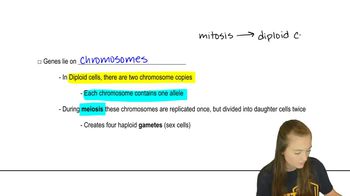
Diploid cells contain two complete sets of chromosomes, one from each parent, denoted as 2n. In Drosophila, the diploid number is 8, meaning there are 4 pairs of chromosomes, including sex chromosomes (XX or XY) and autosomes. Haploid cells, on the other hand, have only one set of chromosomes (n) and are produced during meiosis, leading to gametes.
Recommended video:
Guided course
27:36
Diploid Genetics

Alleles and Genotype

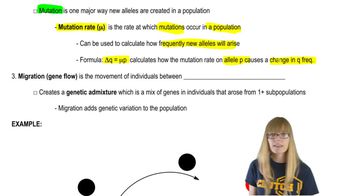
Alleles are different versions of a gene that can exist at a specific locus on a chromosome. The genotype refers to the specific combination of alleles an organism possesses for a given trait. In the case of the Drosophila male, it has a specific allele A₁ on the X chromosome and is heterozygous for alleles B₁/B₂, C₁/C₂, and D₁/D₂ on its autosomes, which defines its genetic makeup.
Recommended video:
Guided course
03:03
New Alleles and Migration

Mitosis and Chromosome Replication

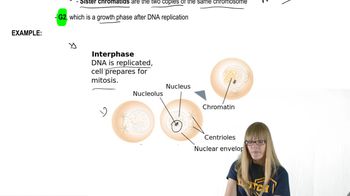
Mitosis is the process of cell division that results in two genetically identical daughter cells, each with the same number of chromosomes as the parent cell. Prior to mitosis, DNA replication occurs, producing sister chromatids for each chromosome. In the context of the Drosophila male, the genotype of the cells produced by mitotic division will reflect the alleles present on the original chromosomes, as no crossover occurs.
Recommended video:
Guided course
09:46
Mitosis Steps
Related Practice
Textbook Question

In Drosophila, the X-linked echinus eye phenotype disrupts formation of facets and is recessive to wild-type eye. Autosomal recessive traits vestigial wing and ebony body assort independently of one another. Examine the progeny from the three crosses shown below, and identify the genotype of parents in each cross.

Textbook Question

A wild-type Drosophila male and female are crossed, producing 324 female progeny and 161 male progeny. All their progeny are wild type.


Propose a genetic hypothesis to explain these data.

3
views
Textbook Question

A wild-type Drosophila male and female are crossed, producing 324 female progeny and 161 male progeny. All their progeny are wild type.


Design an experiment that will test your hypothesis, using the wild-type progeny identified above. Describe the results you expect if your hypothesis is true.

3
views
Textbook Question

Drosophila has a diploid chromosome number of 2n = 8, which includes one pair of sex chromosomes (XX in females and XY in males) and three pairs of autosomes. Consider a Drosophila male that has a copy of the A₁ allele on its X chromosome (the Y chromosome is the homolog) and is heterozygous for alleles B₁ and B₂, C₁ and C₂, and D₁ and D₂ of genes that are each on a different autosomal pair. In the diagrams requested below, indicate the alleles carried on each chromosome and sister chromatid. Assume that no crossover occurs between homologous chromosomes.

Diagram any correct alignment of chromosomes at mitotic metaphase.

1
views
Textbook Question

Drosophila has a diploid chromosome number of 2n = 8, which includes one pair of sex chromosomes (XX in females and XY in males) and three pairs of autosomes. Consider a Drosophila male that has a copy of the A₁ allele on its X chromosome (the Y chromosome is the homolog) and is heterozygous for alleles B₁ and B₂, C₁ and C₂, and D₁ and D₂ of genes that are each on a different autosomal pair. In the diagrams requested below, indicate the alleles carried on each chromosome and sister chromatid. Assume that no crossover occurs between homologous chromosomes.


Diagram any correct alignment of chromosomes at metaphase I of meiosis.

1
views
Textbook Question

Drosophila has a diploid chromosome number of 2n = 8, which includes one pair of sex chromosomes (XX in females and XY in males) and three pairs of autosomes. Consider a Drosophila male that has a copy of the A₁ allele on its X chromosome (the Y chromosome is the homolog) and is heterozygous for alleles B₁ and B₂, C₁ and C₂, and D₁ and D₂ of genes that are each on a different autosomal pair. In the diagrams requested below, indicate the alleles carried on each chromosome and sister chromatid. Assume that no crossover occurs between homologous chromosomes.

For the metaphase I alignment shown in (c), what gamete genotypes are produced at the end of meiosis?

1
views