Pearson+ LogoPearson+ Logo
Ch. 3 - Cell Division and Chromosome Heredity
Sanders - Genetic Analysis: An Integrated Approach 3rd Edition
Sanders3rd EditionGenetic Analysis: An Integrated ApproachISBN: 9780135564172Not the one you use?Change textbook
Chapter 3, Problem 29a

A wild-type Drosophila male and female are crossed, producing 324 female progeny and 161 male progeny. All their progeny are wild type.


Propose a genetic hypothesis to explain these data.

Verified step by step guidance
1
Step 1: Begin by analyzing the phenotypic data provided. The progeny consists of 324 females and 161 males, all of which are wild type. This suggests that the wild-type phenotype is dominant and is expressed in all offspring.
Step 2: Consider the sex ratio of the progeny. The ratio of females to males is approximately 2:1. This deviates from the expected 1:1 sex ratio typically observed in Drosophila crosses, indicating that there may be a genetic factor influencing the sex ratio.
Step 3: Propose a hypothesis involving sex-linked inheritance. In Drosophila, sex is determined by the X and Y chromosomes. A genetic factor on the X chromosome could be influencing the survival or viability of male progeny, leading to fewer males.
Step 4: Suggest that the wild-type parents may carry a recessive lethal allele on the X chromosome. If the male parent carries this allele, it would be passed to male progeny (XY), resulting in lethality. Female progeny (XX) would inherit one wild-type X chromosome and one X chromosome with the recessive lethal allele, but they would survive due to the presence of the wild-type allele.
Step 5: To test this hypothesis, propose conducting additional crosses. For example, cross the wild-type female with another male that does not carry the recessive lethal allele. If the sex ratio returns to 1:1, this would support the hypothesis of a recessive lethal allele on the X chromosome affecting male progeny.

Verified video answer for a similar problem:

This video solution was recommended by our tutors as helpful for the problem above.
Video duration:
2m
Was this helpful?

Key Concepts

Here are the essential concepts you must grasp in order to answer the question correctly.

Sex-linked Inheritance

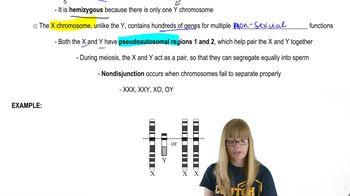
In Drosophila, certain traits are often linked to sex chromosomes, particularly the X chromosome. Males have one X and one Y chromosome, while females have two X chromosomes. This can lead to different inheritance patterns for traits depending on the sex of the parent, which is crucial for understanding the progeny ratios observed in the cross.
Recommended video:
Guided course
07:56
Sex-Linked Genes

Wild-type Phenotype

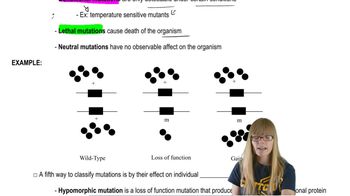
The wild-type phenotype refers to the most common or typical form of a trait found in a natural population. In this case, all progeny being wild type suggests that the alleles for the traits being studied are dominant, and the wild-type allele is likely present in both parents, leading to the observed progeny phenotype.
Recommended video:
Guided course
10:48
Mutations and Phenotypes

Progeny Ratio Analysis

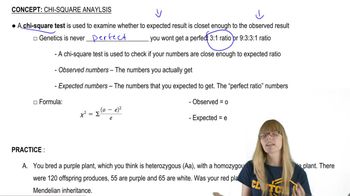
Analyzing the ratio of male to female progeny can provide insights into the genetic mechanisms at play. In this scenario, the ratio of 324 females to 161 males suggests a potential sex-linked inheritance pattern, where the trait is carried on the X chromosome, influencing the expected ratios of offspring based on parental genotypes.
Recommended video:
Guided course
02:48
Chi Square Analysis
Related Practice
Textbook Question

In humans, SRY is located near a pseudoautosomal region (PAR) of the Y chromosome, a region of homology between the X and Y chromosomes that allows them to synapse during meiosis in males and is a region of crossover between the chromosomes. The diagram below shows SRY in relation to the pseudoautosomal region.

About 1 in every 25,000 newborn infants is born with sex reversal; the infant is either an apparent male but with two X chromosomes or an apparent female but with an X and a Y chromosome. Explain the origin of sex reversal in human males and females involving the SRY gene. (Hint: See Experimental Insight 3.1 for a clue about the mutational mechanism.) 

3
views
Textbook Question

In an 1889 book titled Natural Inheritance (Macmillan, New York), Francis Galton, who investigated the inheritance of measurable (quantitative) traits, formulated a law of 'ancestral inheritance.' The law stated that individuals inherit approximately one-half of their genetic traits from each parent, about one-quarter of the traits from each grandparent, one-eighth from each great grandparent, and so on. In light of the chromosome theory of heredity, argue either in favor of Galton's law or against it.

Textbook Question

In Drosophila, the X-linked echinus eye phenotype disrupts formation of facets and is recessive to wild-type eye. Autosomal recessive traits vestigial wing and ebony body assort independently of one another. Examine the progeny from the three crosses shown below, and identify the genotype of parents in each cross.

Textbook Question

A wild-type Drosophila male and female are crossed, producing 324 female progeny and 161 male progeny. All their progeny are wild type.


Design an experiment that will test your hypothesis, using the wild-type progeny identified above. Describe the results you expect if your hypothesis is true.

3
views
Textbook Question

Drosophila has a diploid chromosome number of 2n = 8, which includes one pair of sex chromosomes (XX in females and XY in males) and three pairs of autosomes. Consider a Drosophila male that has a copy of the A₁ allele on its X chromosome (the Y chromosome is the homolog) and is heterozygous for alleles B₁ and B₂, C₁ and C₂, and D₁ and D₂ of genes that are each on a different autosomal pair. In the diagrams requested below, indicate the alleles carried on each chromosome and sister chromatid. Assume that no crossover occurs between homologous chromosomes.

What is the genotype of cells produced by mitotic division in this male?

1
views
Textbook Question

Drosophila has a diploid chromosome number of 2n = 8, which includes one pair of sex chromosomes (XX in females and XY in males) and three pairs of autosomes. Consider a Drosophila male that has a copy of the A₁ allele on its X chromosome (the Y chromosome is the homolog) and is heterozygous for alleles B₁ and B₂, C₁ and C₂, and D₁ and D₂ of genes that are each on a different autosomal pair. In the diagrams requested below, indicate the alleles carried on each chromosome and sister chromatid. Assume that no crossover occurs between homologous chromosomes.

Diagram any correct alignment of chromosomes at mitotic metaphase.

1
views