Pearson+ LogoPearson+ Logo
Ch. 16 - Genomics: Genetics from a Whole-Genome Perspective
Sanders - Genetic Analysis: An Integrated Approach 3rd Edition
Sanders3rd EditionGenetic Analysis: An Integrated ApproachISBN: 9780135564172Not the one you use?Change textbook
Chapter 16, Problem B.14b

Select one of the hereditary conditions from either the RUSP core conditions list or the RUSP list of secondary conditions and do some online research to find the following information:
The defect that characterizes the condition.

Verified step by step guidance
1
Choose a hereditary condition from the RUSP (Recommended Uniform Screening Panel) core or secondary conditions list. For example, you might select Phenylketonuria (PKU) or Cystic Fibrosis.
Research the genetic basis of the chosen condition, focusing on the specific gene or genes involved. Identify the type of mutation or defect that causes the disorder, such as a point mutation, deletion, or insertion.
Understand how this genetic defect affects the function of the gene product (usually a protein), and how this leads to the symptoms or characteristics of the condition.
Summarize the molecular defect by describing the gene involved, the nature of the mutation, and the resulting biochemical or physiological impact.
Optionally, explore how this defect is inherited (e.g., autosomal recessive, autosomal dominant, X-linked) to deepen your understanding of the hereditary pattern.

Verified video answer for a similar problem:

This video solution was recommended by our tutors as helpful for the problem above.
Video duration:
1m
Was this helpful?

Key Concepts

Here are the essential concepts you must grasp in order to answer the question correctly.

Newborn Screening and the RUSP

The Recommended Uniform Screening Panel (RUSP) is a list of core and secondary conditions that newborns are routinely screened for in the United States. Understanding the RUSP helps identify which hereditary conditions are prioritized for early detection to prevent severe health outcomes.
Recommended video:
Guided course
09:32
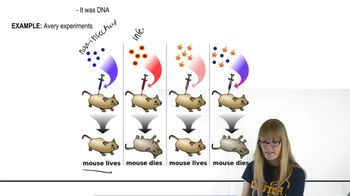
History and Experiments

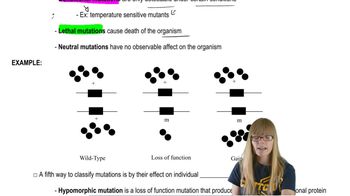
Genetic Defects and Mutations

A genetic defect refers to an abnormality in the DNA sequence that causes a hereditary condition. These defects can be mutations in a single gene or larger chromosomal changes, leading to altered protein function or regulation, which underlies the disease.
Recommended video:
Guided course
10:48
Mutations and Phenotypes

Hereditary Condition Pathophysiology

Pathophysiology describes how a genetic defect disrupts normal biological processes, causing the symptoms of a hereditary condition. Understanding this mechanism is essential to link the genetic defect to clinical manifestations and potential treatments.
Recommended video:
Guided course
05:48
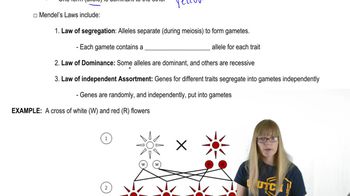
Mendel's Laws
Related Practice
Textbook Question

Imagine yourself in the same position as Kristen Powers, faced with the decision of whether or not to undergo a genetic test that will discover if you have inherited Huntington disease. List five life decisions or choices that you think are likely to be affected by the results of the genetic test. Do you think you would make the same choice to test that Kristen made? Why or why not?

Textbook Question

Go to http://blast.ncbi.nlm.nih.gov/Blast.cgi and follow the links to nucleotide BLAST. Type in the sequence below; it is broken up into codons to make it easier to copy.

5' ATG TTC GTC AAT CAG CAC CTT TGT GGT TCT CAC CTC GTT GAA GCTTTG TAC CTT GTT TGC GGT GAA CGT GGT TTC TTC TAC ACT CCT AAG ACT TAA 3'

As you will note on the BLAST page, there are several options for tailoring your query to obtain the most relevant information. Some are related to which sequences to search in the database. For example, the search can be limited taxonomically (e.g., restricted to mammals) or by the type of sequences in the database (e.g., cDNA or genomic). For our search, we will use the broadest database, the 'Nucleotide collection (nr/nt).' This is the nonredundant (nr) database of all nucleotide data (nt) in GenBank and can be selected in the 'Database' dialogue box. Other parameters can also be adjusted to make the search more or less sensitive to mismatches or gaps. For our purposes, we will use the default setting, which is automatically presented. Press 'BLAST' to search. What can you say about the DNA sequence?

Textbook Question

Select one of the hereditary conditions from either the RUSP core conditions list or the RUSP list of secondary conditions and do some online research to find the following information:

The symptoms and consequences of the condition if it is not treated.

Textbook Question

Select one of the hereditary conditions from either the RUSP core conditions list or the RUSP list of secondary conditions and do some online research to find the following information: The frequency of the condition in newborn infants (note any populations in which the condition is more frequent)

Textbook Question

Select one of the hereditary conditions from either the RUSP core conditions list or the RUSP list of secondary conditions and do some online research to find the following information:

The duration of treatment

Textbook Question

Select one of the hereditary conditions from either the RUSP core conditions list or the RUSP list of secondary conditions and do some online research to find the following information:

The anticipated outcome if treatment is applied