Pearson+ LogoPearson+ Logo
Ch. 15 - Recombinant DNA Technology and Its Applications
Sanders - Genetic Analysis: An Integrated Approach 3rd Edition
Sanders3rd EditionGenetic Analysis: An Integrated ApproachISBN: 9780135564172Not the one you use?Change textbook
Chapter 15, Problem E.3

What is the exclusion principle? How is it used in forensic genetic analysis and in paternity determination?

Verified step by step guidance
1
Understand the exclusion principle: It is a concept used in genetics where an individual can be excluded as a biological parent if they do not share the necessary genetic markers with the child. This principle relies on the fact that a child inherits half of their genetic material from each parent.
Learn how the exclusion principle applies in forensic genetic analysis: In forensic cases, DNA profiles from crime scene evidence are compared to suspects. If a suspect's DNA does not match the evidence at key genetic loci, they can be excluded as the source of that DNA, helping to narrow down or eliminate suspects.
Explore the use of the exclusion principle in paternity determination: By comparing the child's genetic markers with those of the alleged father, if the alleged father lacks the genetic markers that must be inherited from him, he can be excluded as the biological father.
Recognize the role of genetic markers (such as STRs - Short Tandem Repeats) in this process: These markers are highly polymorphic and inherited in a Mendelian fashion, making them ideal for exclusion analysis.
Summarize that the exclusion principle is a powerful tool because it provides definitive evidence to rule out individuals who cannot be biological parents or contributors to a DNA sample, thus aiding in both forensic investigations and paternity testing.

Verified video answer for a similar problem:

This video solution was recommended by our tutors as helpful for the problem above.
Video duration:
4m
Was this helpful?

Key Concepts

Here are the essential concepts you must grasp in order to answer the question correctly.

Exclusion Principle

The exclusion principle in genetics states that if an individual lacks a specific genetic marker found in another, they can be excluded as a biological parent or contributor. It is a method to rule out possible relationships or sources based on incompatible genetic evidence.
Recommended video:

Forensic Genetic Analysis

Forensic genetic analysis uses DNA profiling to identify individuals or biological relationships in legal contexts. By comparing genetic markers, it helps exclude or include suspects or contributors to a crime scene, ensuring accurate identification.
Recommended video:
Guided course
02:48
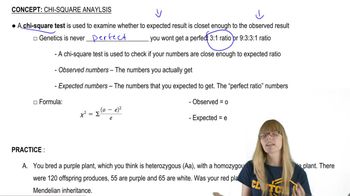
Chi Square Analysis

Paternity Determination

Paternity determination involves comparing the child's genetic markers with those of the alleged father. The exclusion principle is applied to rule out men who do not share necessary genetic markers, thereby confirming or excluding biological fatherhood.
Recommended video:
Guided course
04:24
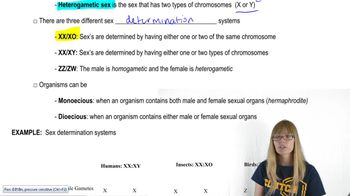
Sex Determination
Related Practice
Textbook Question

Ligase catalyzes a reaction between the 5′ phosphate and the 3′ hydroxyl groups at the ends of DNA molecules. The enzyme calf intestinal phosphatase catalyzes the removal of the 5′5′ phosphate from DNA molecules. What would be the consequence of treating a cloning vector, before ligation, with calf intestinal phosphatase?

Textbook Question

The human genome is 3×10⁹ bp in length.

How many fragments would be predicted to result from the complete digestion of the human genome with the following enzymes: Sau3A (˘GATC), BamHI (G˘GATCC), EcoRI (G˘AATTC), and NotI (GC˘GGCCGC)?

Textbook Question

The human genome is 3×10⁹ bp in length.

How would your initial answer change if you knew that the average GC content of the human genome was 40%?

Textbook Question

What is the statistical principle underlying genetic health risk assessment? Why are these assessments not predictive of disease occurrence?

Textbook Question

You have constructed four different libraries: a genomic library made from DNA isolated from human brain tissue, a genomic library made from DNA isolated from human muscle tissue, a human brain cDNA library, and a human muscle cDNA library.

Which of these would have the greatest diversity of sequences?

Textbook Question

You have constructed four different libraries: a genomic library made from DNA isolated from human brain tissue, a genomic library made from DNA isolated from human muscle tissue, a human brain cDNA library, and a human muscle cDNA library.

Would the sequences contained in each library be expected to overlap completely, partially, or not at all with the sequences present in each of the other libraries?