Ligase catalyzes a reaction between the 5′ phosphate and the 3′ hydroxyl groups at the ends of DNA molecules. The enzyme calf intestinal phosphatase catalyzes the removal of the 5′5′ phosphate from DNA molecules. What would be the consequence of treating a cloning vector, before ligation, with calf intestinal phosphatase?
Ch. 15 - Recombinant DNA Technology and Its Applications

Sanders3rd EditionGenetic Analysis: An Integrated ApproachISBN: 9780135564172Not the one you use?Change textbook
Chapter 15, Problem 2b
The human genome is 3×10⁹ bp in length.
How would your initial answer change if you knew that the average GC content of the human genome was 40%?
Verified step by step guidance1
Step 1: Understand the problem. The human genome is 3×10⁹ base pairs (bp) in length, and the average GC content is 40%. GC content refers to the percentage of guanine (G) and cytosine (C) bases in the genome. The remaining 60% would consist of adenine (A) and thymine (T) bases.
Step 2: Calculate the total number of GC base pairs. Multiply the total genome length (3×10⁹ bp) by the GC content percentage (40%). Use the formula: .
Step 3: Calculate the total number of AT base pairs. Subtract the number of GC base pairs from the total genome length. Use the formula: .
Step 4: If needed, determine the number of each individual base (G, C, A, T). Since GC pairs are equally distributed between G and C, divide the total GC base pairs by 2 to find the number of G and C bases. Similarly, divide the total AT base pairs by 2 to find the number of A and T bases.
Step 5: Summarize the results. The GC content changes the distribution of bases in the genome, affecting calculations related to base composition, melting temperature, and other genomic properties.

Verified video answer for a similar problem:
This video solution was recommended by our tutors as helpful for the problem above.
Video duration:
2mWas this helpful?
Key Concepts
Here are the essential concepts you must grasp in order to answer the question correctly.
Human Genome Size
The human genome consists of approximately 3 billion base pairs (bp), which encodes the genetic information necessary for the development and functioning of a human being. Understanding the size of the genome is crucial for grasping the complexity of genetic information and its implications in genetics, genomics, and evolutionary biology.
Recommended video:
Guided course
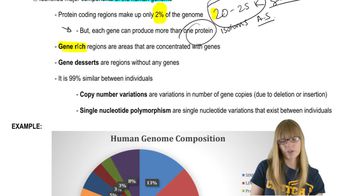
Human Genome Composition
GC Content
GC content refers to the percentage of guanine (G) and cytosine (C) bases in a DNA molecule. In the human genome, an average GC content of 40% indicates that 40% of the base pairs are either G or C. This metric is important as it can influence the stability of the DNA molecule, gene expression, and the overall structure of the genome.
Recommended video:
Guided course
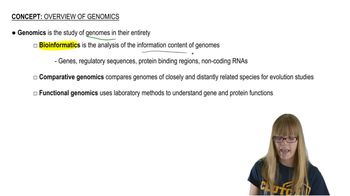
Genomics Overview
Implications of GC Content on Genome Function
The GC content can affect various genomic features, including mutation rates, recombination frequency, and the binding affinity of proteins to DNA. A higher GC content often correlates with increased stability of the DNA double helix, which can impact gene regulation and the evolution of genomic regions. Understanding these implications is essential for interpreting genetic data and its biological significance.
Recommended video:
Guided course
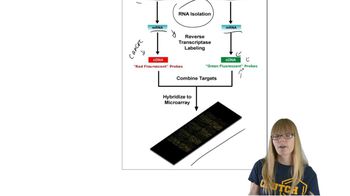
Functional Genomics
Related Practice
Textbook Question
Textbook Question
What is CODIS? Describe the four most important features of genetic markers used in this system.
Textbook Question
Compare and contrast the terms Paternity Index (PI) and Combined Paternity Index (CPI). How does each contribute to paternity determination?
Textbook Question
The human genome is 3×10⁹ bp in length.
How many fragments would be predicted to result from the complete digestion of the human genome with the following enzymes: Sau3A (˘GATC), BamHI (G˘GATCC), EcoRI (G˘AATTC), and NotI (GC˘GGCCGC)?
Textbook Question
What is the exclusion principle? How is it used in forensic genetic analysis and in paternity determination?
Textbook Question
What is the statistical principle underlying genetic health risk assessment? Why are these assessments not predictive of disease occurrence?
