
Textbook Question
Compare and contrast methods for making transgenic plants and transgenic Drosophila.


 Verified step by step guidance
 06:59
06:59
 04:37
04:37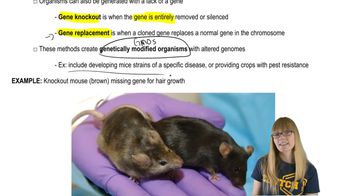 09:12
09:12Compare and contrast methods for making transgenic plants and transgenic Drosophila.
In an inheritance case, a man has died leaving his estate to be divided equally between 'his wife and his offspring.' His wife (M) has an adult daughter (D), and they argue that they should split the estate equally. As a young couple, however, the man and his wife had a son that they gave up for adoption. Two men have appeared, each claiming to be the son of the couple and therefore entitled to a one-third share of the estate. The accompanying illustration shows the results of DNA analysis for five genes for the mother (M), her daughter (D), and the two claimants (S1 and S2). Do the DNA results suggest that either man is likely to be the son of the man and his wife? Explain.
The frequencies of the four alleles contributed to the child by possible father F1 in Problem 7 are 0.18, 0.23, 0.13, and 0.14. Make a statement about the possible paternity of F1 based on this analysis.
The frequencies of the four alleles contributed to the child by possible father F1 in Problem 7 are 0.18, 0.23, 0.13, and 0.14. Calculate the Combined Paternity Index (CPI) for the four genes in this analysis.
In an inheritance case, a man has died leaving his estate to be divided equally between 'his wife and his offspring.' His wife (M) has an adult daughter (D), and they argue that they should split the estate equally. As a young couple, however, the man and his wife had a son that they gave up for adoption. Two men have appeared, each claiming to be the son of the couple and therefore entitled to a one-third share of the estate. The accompanying illustration shows the results of DNA analysis for five genes for the mother (M), her daughter (D), and the two claimants (S1 and S2). How many nonmaternal DNA bands are shared by D and S1? By D and S2?