Pearson+ LogoPearson+ Logo
Ch. 12 - Regulation of Gene Expression in Bacteria and Bacteriophage
Sanders - Genetic Analysis: An Integrated Approach 3rd Edition
Sanders3rd EditionGenetic Analysis: An Integrated ApproachISBN: 9780135564172Not the one you use?Change textbook
Chapter 12, Problem 10

How would a cap⁻ mutation that produces an inactive CAP protein affect transcriptional control of the lac operon?

Verified step by step guidance
1
Understand the role of the CAP protein in the lac operon: CAP (catabolite activator protein) is a regulatory protein that facilitates the binding of RNA polymerase to the promoter of the lac operon, enhancing transcription. CAP requires cAMP to bind to the DNA at the CAP site.
Recognize the impact of a cap⁻ mutation: A cap⁻ mutation results in an inactive CAP protein. This means that CAP cannot bind to the CAP site on the DNA, even in the presence of cAMP.
Analyze the effect on transcription: Without CAP binding, RNA polymerase has difficulty binding efficiently to the promoter of the lac operon. This leads to reduced transcription of the operon, even when lactose is present and glucose levels are low.
Consider the physiological context: The lac operon is normally activated when glucose is scarce and lactose is available. The cap⁻ mutation disrupts this regulatory mechanism, leading to poor expression of the lac operon regardless of glucose levels.
Conclude the overall effect: The cap⁻ mutation results in a significant reduction in the transcriptional activation of the lac operon, impairing the cell's ability to metabolize lactose efficiently under conditions where it would normally do so.

Verified video answer for a similar problem:

This video solution was recommended by our tutors as helpful for the problem above.
Video duration:
4m
Was this helpful?

Key Concepts

Here are the essential concepts you must grasp in order to answer the question correctly.

CAP Protein Function

The CAP (catabolite activator protein) is a transcription factor that enhances the expression of certain genes, including the lac operon, in response to low glucose levels. When glucose is scarce, CAP binds to cyclic AMP (cAMP), forming a complex that promotes RNA polymerase binding to the promoter of the lac operon, facilitating transcription.
Recommended video:

Lac Operon Structure

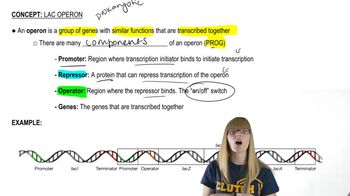
The lac operon is a set of genes in E. coli that are involved in the metabolism of lactose. It consists of three structural genes (lacZ, lacY, and lacA) and regulatory elements, including the promoter and operator. The operon is typically off when glucose is present but can be activated in the absence of glucose, allowing the bacteria to utilize lactose as an energy source.
Recommended video:
Guided course
04:27
Lac Operon Overview

Transcriptional Control Mechanisms

Transcriptional control mechanisms regulate gene expression in response to environmental changes. In the case of the lac operon, the presence of glucose inhibits cAMP production, leading to reduced CAP-cAMP complex formation. A cap⁻ mutation that produces an inactive CAP protein would prevent this activation, resulting in decreased transcription of the lac operon, even when lactose is available.
Recommended video:
Guided course
09:16
Eukaryotic Transcription