Ch. 11 - Gene Mutation, DNA Repair, and Homologous Recombination
Sanders - Genetic Analysis: An Integrated Approach 3rd Edition
Sanders3rd EditionGenetic Analysis: An Integrated ApproachISBN: 9780135564172Not the one you use?Change textbook
Chapter 11, Problem 6b

Ultraviolet (UV) radiation is mutagenic.
How do UV-induced DNA lesions lead to mutation?

Verified step by step guidance
1
Understand the nature of UV radiation: UV radiation is a form of electromagnetic radiation with wavelengths shorter than visible light. It is capable of causing damage to DNA by inducing chemical changes in the nucleotide bases.
Learn about UV-induced DNA lesions: UV radiation primarily causes the formation of pyrimidine dimers, such as thymine-thymine dimers or cytosine-thymine dimers. These lesions occur when adjacent pyrimidine bases on the same DNA strand become covalently bonded.
Explore the consequences of pyrimidine dimers: Pyrimidine dimers distort the DNA double helix structure, interfering with normal DNA replication and transcription processes. This can lead to errors during DNA synthesis.
Understand how mutations arise: If the DNA repair mechanisms, such as nucleotide excision repair, fail to correct the UV-induced lesions, DNA polymerase may insert incorrect bases opposite the damaged site during replication. This results in permanent changes to the DNA sequence, known as mutations.
Connect to broader implications: Mutations caused by UV radiation can lead to various outcomes, including cell death, malfunction, or uncontrolled cell growth (e.g., cancer). This highlights the importance of DNA repair systems in maintaining genomic integrity.

Verified video answer for a similar problem:

This video solution was recommended by our tutors as helpful for the problem above.
Video duration:
2m
Was this helpful?

Key Concepts

Here are the essential concepts you must grasp in order to answer the question correctly.

UV Radiation and DNA Damage

Ultraviolet (UV) radiation can cause direct damage to DNA by inducing the formation of pyrimidine dimers, primarily thymine dimers. These dimers result from covalent bonding between adjacent thymine bases, disrupting the normal base pairing and leading to distortions in the DNA structure. If not repaired, these lesions can interfere with DNA replication and transcription.
Recommended video:
Guided course
01:45
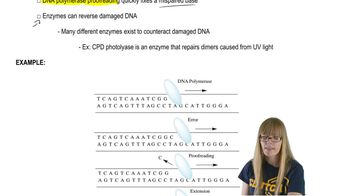
DNA Proofreading

DNA Repair Mechanisms

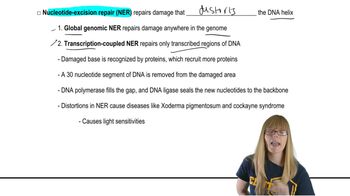
Cells have evolved several DNA repair mechanisms to correct UV-induced lesions, including nucleotide excision repair (NER) and photoreactivation. NER removes damaged sections of DNA and synthesizes new DNA to fill the gap, while photoreactivation directly reverses thymine dimers using light energy. Failure or inefficiency in these repair processes can lead to permanent mutations.
Recommended video:
Guided course
05:44
Repair Pathways

Mutation and Its Consequences

A mutation is a permanent alteration in the DNA sequence that can arise from unrepaired lesions. These mutations can lead to changes in protein function, potentially resulting in harmful effects such as cancer or genetic disorders. Understanding how UV-induced mutations occur is crucial for studying the mechanisms of carcinogenesis and the importance of DNA repair in maintaining genomic stability.
Recommended video:
Guided course
10:48
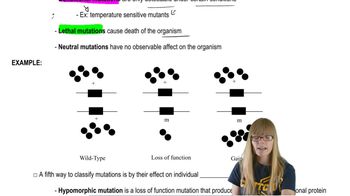
Mutations and Phenotypes
Related Practice
Textbook Question

In March 2011 an earthquake measuring approximately 9.0 on the Richter scale struck Fukushima, Japan. Several nuclear reactors at the Fukushima Daichii Nuclear Power Plant were damaged, and nuclear core meltdown occurred. A massive release of radiation accompanied damage to the plant, and 5 years later the incidence of thyroid cancer in children exposed to the radiation was determined to be well over 100 times more frequent than expected without radiation exposure. DNA damage and mutations resulting from radiation exposure are suspected of causing this increased cancer rate. What gene discussed in this chapter might be responsible for pausing the cell cycle of dividing cells long enough for radiation-induced damage to be repaired in cells?

Textbook Question

In March 2011 an earthquake measuring approximately 9.0 on the Richter scale struck Fukushima, Japan. Several nuclear reactors at the Fukushima Daichii Nuclear Power Plant were damaged, and nuclear core meltdown occurred. A massive release of radiation accompanied damage to the plant, and 5 years later the incidence of thyroid cancer in children exposed to the radiation was determined to be well over 100 times more frequent than expected without radiation exposure. DNA damage and mutations resulting from radiation exposure are suspected of causing this increased cancer rate. Do you think it is possible that significant increases in the incidence of other types of cancer will occur in the future among people who were exposed to the Fukushima radiation? Why?

3
views
Textbook Question

Ultraviolet (UV) radiation is mutagenic.

What kind of DNA lesion does UV energy cause?

Textbook Question

Ultraviolet (UV) radiation is mutagenic.

Identify and describe two DNA repair mechanisms that remove UV-induced DNA lesions.

Textbook Question

Researchers interested in studying mutation and mutation repair often induce mutations with various agents. What kinds of gene mutations are induced by

Chemical mutagens? Give two examples.

Textbook Question

Researchers interested in studying mutation and mutation repair often induce mutations with various agents. What kinds of gene mutations are induced by

Radiation energy? Give two examples.