Back
Back
Problem 9
Graph each function. Determine the largest open intervals of the domain over which each function is (a) increasing or (b) decreasing. ƒ(x)=2x4
Problem 9
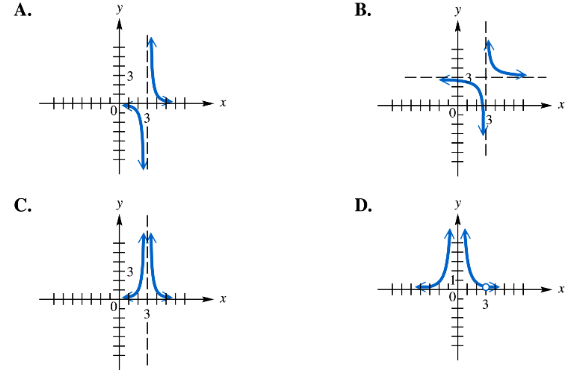
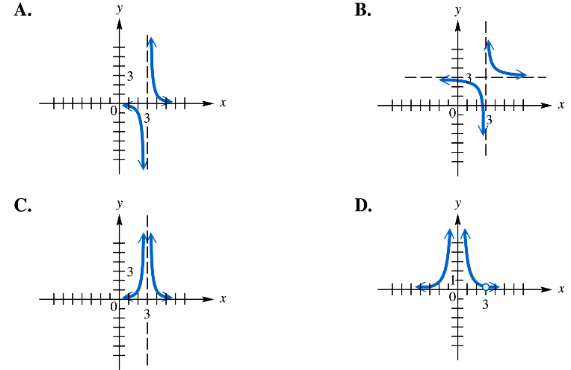
Use the graphs of the rational functions in choices A–D to answer each question.
There may be more than one correct choice. Which choices have domain (-∞, 3)U(3, ∞)?
Problem 9
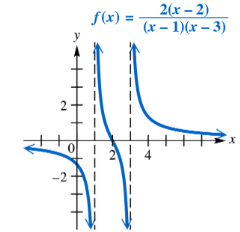
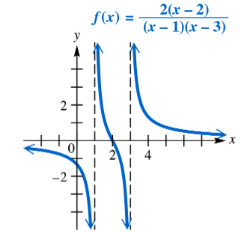
Use the graph to solve each equation or inequality. Use interval notation where appropriate. 2(x-2) / {(x-1)(x-3)} > 0
Problem 9
Use synthetic division to perform each division. (5x4 +5x3 + 2x2 - x-3) / x+1
Problem 9
Use the factor theorem and synthetic division to determine whether the second polynomial is a factor of the first. x3-5x2+3x+1; x-1
Problem 9
Solve each problem. If m varies jointly as x and y, and m=10 when x=2 and y=14, find m when x=21 and y=8.
Problem 10
Use the graph to solve each equation or inequality. Use interval notation where appropriate. 2(x-2) / {(x-1)(x-3)} ≤ 0
Problem 10
Use the factor theorem and synthetic division to determine whether the second polynomial is a factor of the first. See Example 1.
Problem 11
Solve each quadratic inequality. Give the solution set in interval notation.
(a) (x - 5)(x + 2) ≥ 0
(b) (x - 5)(x + 2) > 0
(c) (x - 5)(x + 2) ≤ 0
(d) (x - 5)(x + 2) < 0
Problem 11
Solve each problem. If y varies inversely as x, and y=10 when x=3, find y when x=20.
Problem 11
Use synthetic division to perform each division. (x4 + 4x3 + 2x2 + 9x+4) / x+4
Problem 11a
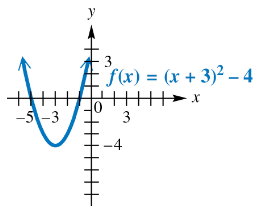
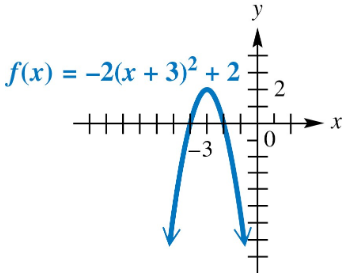
Consider the graph of each quadratic function.
a) Give the domain and range.
Problem 12
Solve each quadratic inequality. Give the solution set in interval notation.
(a) -(x + 1)(x + 2) ≥ 0
(b) -(x + 1)(x + 2) > 0
(c) -(x + 1)(x + 2) ≤ 0
(d) -(x + 1)(x + 2) < 0
Problem 12
Use synthetic division to perform each division. (3x3+6x2-8x+3)/(x+3)
Problem 13
Solve each problem. Suppose r varies directly as the square of m, and inversely as s. If r=12 when m=6 and s=4, find r when m=6 and s=20.
Problem 13
Use synthetic division to divide ƒ(x) by x-k for the given value of k. Then express ƒ(x) in the form ƒ(x)=(x-k)q(x)+r. ƒ(x)=5x3-3x2+2x-6; k=2
Problem 13
Use the graphs of the rational functions in choices A–D to answer each question.
There may be more than one correct choice. If ƒ represents the function, only one choice has a single solution to the equation ƒ(x)=3. Which one is it?
Problem 13
Solve each quadratic inequality. Give the solution set in interval notation. - ( x +√2)(x-3) < 0
Problem 13
Use synthetic division to perform each division. (x5 + 3x4 + 2x3 + 2x2 + 3x+1) / x+2
Problem 13a
Consider the graph of each quadratic function.
(a) Give the domain and range.
Problem 14
Use synthetic division to divide ƒ(x) by x-k for the given value of k. Then express ƒ(x) in the form ƒ(x)=(x-k)q(x)+r. ƒ(x)=-3x3+5x-6; k=-1
Problem 14
Solve each quadratic inequality. Give the solution set in interval notation. (x-4)(x + √2) < 0
Problem 15
Use the factor theorem and synthetic division to determine whether the second polynomial is a factor of the first. 4x2+2x+54; x-4
Problem 15
Use synthetic division to perform each division. (-9x3 + 8x2 - 7x+2) / x-2
Problem 15
Solve each quadratic inequality. Give the solution set in interval notation. (x - 4)2 ≤ 0
Problem 15
Solve each problem. Let a be directly proportional to m and n2, and inversely proportional to y3. If a=9when m=4, n=9, and y=3, find a when m=6, n=2, and y=5.
Problem 15
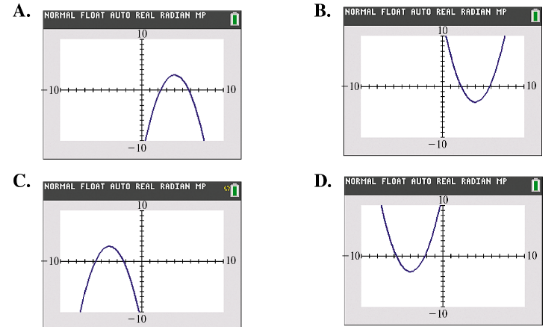
Match each function with its graph without actually entering it into a calculator. Then, after completing the exercises, check the answers with a calculator. Use the standard viewing window. ƒ(x) = (x - 4)2 - 3
Problem 16
Solve each quadratic inequality. Give the solution set in interval notation. -(x + 1)2 ≥ 0
Problem 16
Use synthetic division to find ƒ(2). ƒ(x)=2x3-3x2+7x-12
Problem 17
Use synthetic division to perform each division.