
Pearson+ LogoPearson+ Logo
Ch. 9 - Cellular Respiration and Fermentation
Freeman - Biological Science 8th Edition
Freeman8th EditionBiological ScienceISBN: 9780138276263Not the one you use?Change textbook
Chapter 9, Problem 7

In step 3 of the citric acid cycle, the enzyme isocitrate dehydrogenase is regulated by NADH. Compare and contrast the regulation of this enzyme with the regulation of phosphofructokinase in glycolysis.

Verified step by step guidance
1
Identify the enzymes and pathways involved: Isocitrate dehydrogenase is an enzyme in the citric acid cycle, which is regulated by NADH. Phosphofructokinase is an enzyme in glycolysis, primarily regulated by ATP and AMP.
Understand the type of regulation: Isocitrate dehydrogenase is inhibited by high levels of NADH, indicating a feedback inhibition mechanism. This is because NADH is a product of the citric acid cycle, and its accumulation suggests that energy production needs to slow down.
Contrast with phosphofructokinase regulation: Phosphofructokinase is inhibited by ATP (high-energy molecule) and activated by AMP (low-energy molecule). This regulation is also a form of feedback inhibition but focuses on the energy status of the cell rather than the concentration of a specific product of the pathway.
Discuss the role of allosteric sites: Both enzymes are allosterically regulated, but the molecules that bind to these sites differ. Isocitrate dehydrogenase has allosteric sites for NADH, while phosphofructokinase has allosteric sites for ATP and AMP.
Examine the physiological implications: The regulation of these enzymes ensures that energy production is balanced according to the cell's needs. Isocitrate dehydrogenase slows the citric acid cycle during high-energy conditions (high NADH), while phosphofructokinase slows glycolysis during energy-rich conditions (high ATP) and speeds it up during energy-poor conditions (high AMP).

Verified video answer for a similar problem:

This video solution was recommended by our tutors as helpful for the problem above.
Video duration:
2m
Was this helpful?

Key Concepts

Here are the essential concepts you must grasp in order to answer the question correctly.

Citric Acid Cycle

The citric acid cycle, also known as the Krebs cycle, is a series of enzymatic reactions that occur in the mitochondria, where acetyl-CoA is oxidized to produce energy in the form of ATP, NADH, and FADH2. It plays a crucial role in cellular respiration, linking carbohydrate, fat, and protein metabolism. Understanding this cycle is essential for analyzing the regulation of enzymes like isocitrate dehydrogenase.
Recommended video:

Enzyme Regulation

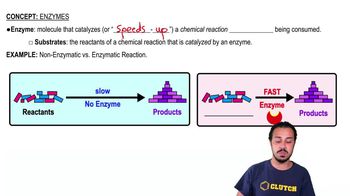
Enzyme regulation refers to the mechanisms that control the activity of enzymes, ensuring metabolic pathways respond appropriately to the cell's needs. This can occur through various means, including allosteric regulation, covalent modification, and feedback inhibition. In the case of isocitrate dehydrogenase, its activity is inhibited by high levels of NADH, indicating sufficient energy supply, while phosphofructokinase in glycolysis is regulated by ATP and citrate, reflecting the energy status of the cell.
Recommended video:

Phosphofructokinase (PFK)

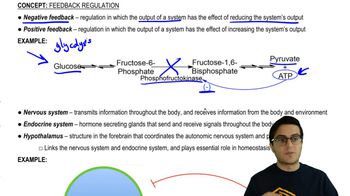
Phosphofructokinase (PFK) is a key regulatory enzyme in glycolysis that catalyzes the conversion of fructose-6-phosphate to fructose-1,6-bisphosphate. It is considered a major control point in the glycolytic pathway and is allosterically inhibited by ATP and citrate, signaling high energy levels, while activated by AMP, indicating low energy. Comparing its regulation with that of isocitrate dehydrogenase highlights different mechanisms of metabolic control in energy production.
Recommended video:
Guided course
08:57
Feedback Regulation
Related Practice
Textbook Question

Which of the following correctly describe the fermentation pathway? Select True or False for each statement.

T/FIt includes a reaction that oxidizes NADH to NAD+.

T/FIt synthesizes ATP by substrate-level phosphorylation.

T/FIt includes a reaction that reduces NAD+ to NADH.

T/FIt synthesizes electron acceptors, so that cellular respiration can continue.

2
views
Textbook Question

Compare and contrast substrate-level phosphorylation and oxidative phosphorylation.

Textbook Question

If you were to expose cells that are undergoing aerobic respiration to a radioactive oxygen isotope in the form of O2, which of the following molecules would you expect to be radiolabeled?

a. Pyruvate

b. Water

c. NADH

d. CO2

Textbook Question

Explain the relationship between electron transport and oxidative phosphorylation. How do uncoupling proteins 'uncouple' this relationship in brown adipose tissue?

Textbook Question

The researchers who observed that magnetite was produced by bacterial cultures from the deep subsurface carried out a follow-up experiment. These biologists treated some of the cultures with a drug that poisons the enzymes involved in electron transport chains. In cultures where the drug was present, no more magnetite was produced. Does this result support or undermine their hypothesis that the bacteria in the cultures perform cellular respiration? Explain your reasoning.

Textbook Question

Cyanide (C ≡ N) blocks complex IV of the electron transport chain. Suggest a hypothesis for what happens to the ETC when complex IV stops working. Your hypothesis should explain why cyanide poisoning in humans is fatal.