
Textbook Question
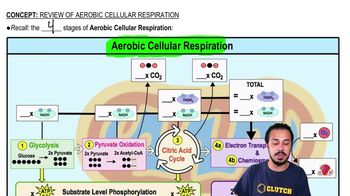
After glucose is fully oxidized by glycolysis, pyruvate processing, and the citric acid cycle, where is most of its energy stored?


 Verified step by step guidance
 07:51
07:51
 07:41
07:41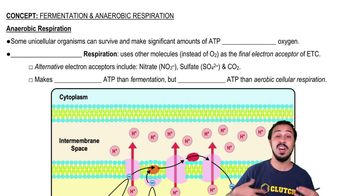 03:35
03:35After glucose is fully oxidized by glycolysis, pyruvate processing, and the citric acid cycle, where is most of its energy stored?
Which of the following correctly describe the fermentation pathway? Select True or False for each statement.
T/FIt includes a reaction that oxidizes NADH to NAD+.
T/FIt synthesizes ATP by substrate-level phosphorylation.
T/FIt includes a reaction that reduces NAD+ to NADH.
T/FIt synthesizes electron acceptors, so that cellular respiration can continue.
Compare and contrast substrate-level phosphorylation and oxidative phosphorylation.
In step 3 of the citric acid cycle, the enzyme isocitrate dehydrogenase is regulated by NADH. Compare and contrast the regulation of this enzyme with the regulation of phosphofructokinase in glycolysis.
The researchers who observed that magnetite was produced by bacterial cultures from the deep subsurface carried out a follow-up experiment. These biologists treated some of the cultures with a drug that poisons the enzymes involved in electron transport chains. In cultures where the drug was present, no more magnetite was produced. Does this result support or undermine their hypothesis that the bacteria in the cultures perform cellular respiration? Explain your reasoning.
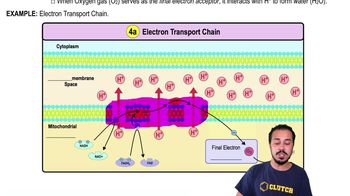
Explain the relationship between electron transport and oxidative phosphorylation. How do uncoupling proteins 'uncouple' this relationship in brown adipose tissue?