Pearson+ LogoPearson+ Logo
Ch. 48 - The Immune System in Animals
Freeman - Biological Science 8th Edition
Freeman8th EditionBiological ScienceISBN: 9780138276263Not the one you use?Change textbook
Chapter 48, Problem 4

What is one of the differences between CD4+ and CD8+ T cells?
a. CD4+ cells are immature, and CD8+ cells are mature.
b. CD4+ cells are activated, and CD8+ cells are not.
c. CD4+ cells interact with class II MHC proteins, and CD8+ cells interact with class I MHC proteins.
d. CD4+ cells activate cell-mediated responses, and CD8+ cells activate humoral responses.

Verified step by step guidance
1
Understand the role of T cells in the immune system: T cells are a type of lymphocyte that play a central role in cell-mediated immunity. They are primarily involved in identifying and destroying infected cells.
Differentiate between CD4+ and CD8+ T cells: CD4+ T cells, also known as helper T cells, assist other cells in the immune response. CD8+ T cells, also known as cytotoxic T cells, directly attack and destroy infected cells.
Identify the interaction with MHC proteins: CD4+ T cells typically interact with antigens presented by class II Major Histocompatibility Complex (MHC) proteins, which are found on the surface of antigen-presenting cells. CD8+ T cells interact with antigens presented by class I MHC proteins, which are present on almost all nucleated cells.
Evaluate the options given in the problem: Option c states that CD4+ cells interact with class II MHC proteins, and CD8+ cells interact with class I MHC proteins. This aligns with the known functions and interactions of these T cell types.
Conclude which option correctly describes the difference: Based on the understanding of T cell interactions with MHC proteins, option c is the correct description of the difference between CD4+ and CD8+ T cells.

Verified video answer for a similar problem:

This video solution was recommended by our tutors as helpful for the problem above.
Video duration:
1m
Was this helpful?

Key Concepts

Here are the essential concepts you must grasp in order to answer the question correctly.

T Cell Differentiation

T cells are a type of lymphocyte that play a central role in cell-mediated immunity. They differentiate into various subtypes, including CD4+ and CD8+ T cells, each with distinct functions. CD4+ T cells, also known as helper T cells, assist other cells in the immune response, while CD8+ T cells, or cytotoxic T cells, directly kill infected cells.
Recommended video:
Guided course
05:28
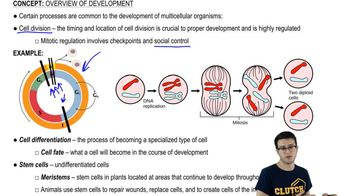
Cell Division and Differentiation

Major Histocompatibility Complex (MHC)

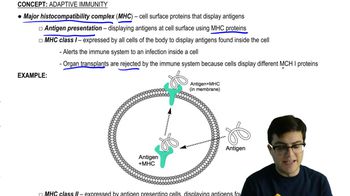
MHC molecules are proteins found on the surfaces of cells that present antigens to T cells. There are two classes: MHC class I, which presents antigens to CD8+ T cells, and MHC class II, which presents antigens to CD4+ T cells. This interaction is crucial for the activation and function of T cells in the immune response.
Recommended video:
Guided course
04:04
Major Histocompatibility Complex

Immune Response Activation

CD4+ and CD8+ T cells are involved in different types of immune responses. CD4+ T cells primarily activate and regulate other immune cells, including B cells and macrophages, facilitating the humoral and cell-mediated immune responses. CD8+ T cells are responsible for the direct killing of infected or cancerous cells, playing a key role in cell-mediated immunity.
Recommended video:
Guided course
05:20
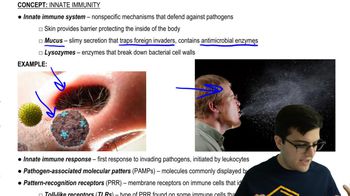
Innate Immune Response
Related Practice
Textbook Question

What is the primary difference between the innate and adaptive immune responses?

a. The innate immune response does not distinguish between pathogens, while the adaptive immune response does.

b. Only the innate immune response is activated by antigens.

c. The adaptive immune response generates immunological memory and is more specific than the innate immune response.

d. The innate immune response does not kill cells; the adaptive immune response does.

Textbook Question

The overall role of the inflammatory response is to

a. Contain and eliminate foreign cells and material at the site of infection.

b. Increase heat at the site of infection to activate enzymes used in the immune response.

c. Produce antibodies that bind to and eliminate invading cells.

d. Increase blood flow at the site of a wound to flush out invading pathogens.

Textbook Question

What is the difference between an epitope and an antigen?

Textbook Question

Explain how gene recombination leads to the production of vast numbers of different B-cell receptors.

Textbook Question

What steps are required for most B cells to become fully activated and differentiate into plasma cells?

Textbook Question

Why is clonal selection necessary for the adaptive immune response but not the innate immune response? Select True or False for each statement.

T/F The adaptive immune response uses receptors to recognize pathogens, and the innate immune response does not.

T/F There is more receptor diversity in the adaptive immune response than in the innate immune response.

T/F Cells in the innate immune response do not require activation, and those in the adaptive immune response do.

T/F Clonal selection is used for targeting pathogens, and the innate immune response is used only to stop blood flow from the wound.