
Pearson+ LogoPearson+ Logo
Ch. 48 - The Immune System in Animals
Freeman - Biological Science 8th Edition
Freeman8th EditionBiological ScienceISBN: 9780138276263Not the one you use?Change textbook
Chapter 48, Problem 7

Why is clonal selection necessary for the adaptive immune response but not the innate immune response? Select True or False for each statement.
T/F The adaptive immune response uses receptors to recognize pathogens, and the innate immune response does not.
T/F There is more receptor diversity in the adaptive immune response than in the innate immune response.
T/F Cells in the innate immune response do not require activation, and those in the adaptive immune response do.
T/F Clonal selection is used for targeting pathogens, and the innate immune response is used only to stop blood flow from the wound.

Verified step by step guidance
1
Understand the difference between adaptive and innate immune responses. The adaptive immune response is specific and has memory, while the innate immune response is non-specific and immediate.
Consider the role of receptors in each type of immune response. The adaptive immune response uses specific receptors to recognize pathogens, whereas the innate immune response uses pattern recognition receptors that are less specific.
Evaluate receptor diversity. The adaptive immune response has a high diversity of receptors due to the recombination of gene segments, allowing it to recognize a wide variety of antigens. The innate immune response has limited receptor diversity.
Analyze the activation requirement for immune cells. Cells in the adaptive immune response require activation through antigen presentation and clonal selection, whereas cells in the innate immune response are ready to act immediately without prior activation.
Clarify the purpose of clonal selection. Clonal selection is a process in the adaptive immune response where specific lymphocytes are selected and proliferated to target specific pathogens. The innate immune response is not involved in clonal selection and is not limited to stopping blood flow from wounds.

Verified video answer for a similar problem:

This video solution was recommended by our tutors as helpful for the problem above.
Video duration:
2m
Was this helpful?

Key Concepts

Here are the essential concepts you must grasp in order to answer the question correctly.

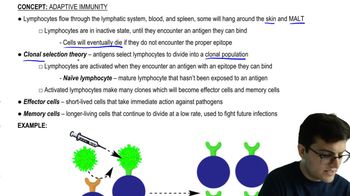
Clonal Selection

Clonal selection is a fundamental mechanism in the adaptive immune response where specific lymphocytes are selected for proliferation based on their ability to recognize and bind to a particular antigen. This process ensures that the immune system can mount a strong and specific response to pathogens. It is not required in the innate immune response, which relies on a more generalized recognition of pathogens.
Recommended video:
Guided course
03:24
Clonal Selection Theory

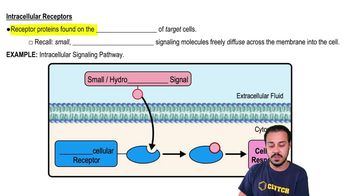
Receptor Diversity

Receptor diversity refers to the vast array of different receptors present on lymphocytes in the adaptive immune system, allowing it to recognize a wide variety of antigens. This diversity is generated through genetic recombination processes. In contrast, the innate immune system has a limited set of receptors that recognize common pathogen-associated molecular patterns, providing a rapid but non-specific response.
Recommended video:
Guided course
02:28
Intracellular Receptors

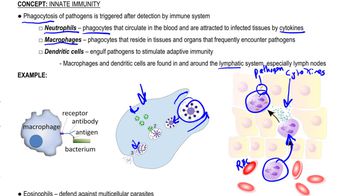
Activation of Immune Cells

Activation of immune cells is a critical step in the adaptive immune response, where lymphocytes require specific signals to become fully functional and proliferate. This ensures a targeted and effective response to pathogens. Innate immune cells, however, are typically ready to respond immediately upon encountering pathogens, without the need for prior activation, providing a first line of defense.
Recommended video:
Guided course
06:47
Innate Immune Cells