


Pearson+ LogoPearson+ Logo
Ch. 48 - The Immune System in Animals
Freeman - Biological Science 8th Edition
Freeman8th EditionBiological ScienceISBN: 9780138276263Not the one you use?Change textbook
Chapter 48, Problem 3

What is the difference between an epitope and an antigen?

Verified step by step guidance
1
An antigen is a molecule or molecular structure, often a protein or polysaccharide, that can be bound by an antigen-specific antibody or antigen receptor on B and T cells. Antigens are typically foreign substances that enter the body and trigger an immune response.
An epitope, also known as an antigenic determinant, is a specific part of the antigen that is recognized and bound by an antibody. It is a small, specific region on the larger antigen molecule.
While an antigen can have multiple epitopes, each epitope is recognized by a specific antibody. This means that a single antigen can stimulate the production of multiple types of antibodies, each specific to a different epitope.
The distinction between an antigen and an epitope is crucial in understanding how the immune system recognizes and responds to pathogens. Antigens are the targets, and epitopes are the precise points where antibodies attach.
In vaccine development, understanding the specific epitopes on an antigen that provoke a strong immune response can help in designing effective vaccines that target these critical regions.

Verified video answer for a similar problem:

This video solution was recommended by our tutors as helpful for the problem above.
Video duration:
1m
Was this helpful?

Key Concepts

Here are the essential concepts you must grasp in order to answer the question correctly.

Antigen

An antigen is a substance that can provoke an immune response in the body. Typically, antigens are foreign molecules such as proteins or polysaccharides found on the surface of pathogens like bacteria and viruses. When detected by the immune system, antigens trigger the production of antibodies, which are specific proteins that help neutralize or eliminate the threat.
Recommended video:
Guided course
03:50
Antigen Receptors

Epitope

An epitope, also known as an antigenic determinant, is a specific part of an antigen that is recognized by the immune system, particularly by antibodies or T-cell receptors. Epitopes can be linear, consisting of a sequence of amino acids, or conformational, formed by the three-dimensional structure of the antigen. The interaction between epitopes and immune receptors is crucial for the specificity of the immune response.
Recommended video:
Guided course
03:43
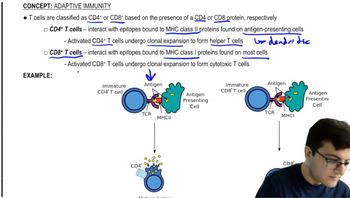
Antigen Presentation and Cytotoxic T Cells

Immune Response

The immune response is the body's defense mechanism against foreign invaders, such as pathogens. It involves the recognition of antigens and the activation of various immune cells, including B cells and T cells. The immune response can be innate (immediate and non-specific) or adaptive (specific and slower to develop), with the latter providing long-term immunity through memory cells that remember specific epitopes.
Recommended video:
Guided course
05:20
Innate Immune Response