


Plants experience a vast array of conditions that can alter their growth and development, including temperature and availability of water, nutrients, and light. They are also exposed to pollutants such as acid rain formed largely as a result of burning fossil fuels and volcanic eruptions. Acid rain can strip minerals and nutrients from the soil, and eat away the outer waxy layer of tissue that protects a plant. Acid rain is still a major environmental problem in certain regions. How does acid rain affect plant growth? Researchers tested the effects of acid rain (pH 2.0) on seedlings of two different species, camphor tree (Cinnamomum camphora) and chinaberry tree (Melia azederach), using distilled water as a control. Results of the experiments are shown here. Note that acid rain caused a significant reduction of growth in chinaberry trees (*** means P < 0.001), but not in camphor trees. What was the approximate percentage of growth reduction observed in the chinaberry trees treated with acid rain?
- Ch. 1 - Biology: The Study of Life13
- Ch. 2 - Water and Carbon: The Chemical Basis of Life14
- Ch.3 - Protein Structure and Function10
- Ch.4 - Nucleic Acids and the RNA World10
- Ch. 5 - An Introduction to Carbohydrates10
- Ch. 6 - Lipids, Membranes, and the First Cells11
- Ch. 7 - Inside the Cell10
- Ch. 8 - Energy and Enzymes: An Introduction to Metabolism10
- Ch. 9 - Cellular Respiration and Fermentation11
- Ch. 10 - Photosynthesis12
- Ch. 11 - Cell-Cell Interactions12
- Ch. 12 - The Cell Cycle8
- Ch. 13 - Meiosis12
- Ch. 14 - Mendel and the Gene23
- Ch. 15 - DNA and the Gene: Synthesis and Repair15
- Ch. 16 - How Genes Work16
- Ch. 17 - Transcription, RNA Processing, and Translation16
- Ch. 18 - Control of Gene Expression in Bacteria16
- Ch. 19 - Control of Gene Expression in Eukaryotes12
- Ch. 20 - The Molecular Revolution: Biotechnology, Genomics, and New Frontiers15
- Ch. 21 - Genes, Development, and Evolution12
- Ch. 22 - Evolution by Natural Selection16
- Ch. 23 - Evolutionary Processes13
- Ch. 24 - Speciation15
- Ch. 25 - Phylogenies and the History of Life13
- Ch. 26 - Bacteria and Archaea15
- Ch. 27 - Diversification of Eukaryotes16
- Ch. 28 - Green Algae and Land Plants16
- Ch. 29 - Fungi18
- Ch. 30 - An Introduction to Animals9
- Ch. 31 - Protostome Animals15
- Ch. 32 - Deuterostome Animals17
- Ch. 33 - Viruses16
- Ch. 34 - Plant Form and Function16
- Ch. 35 - Water and Sugar Transport in Plants16
- Ch. 36 - Plant Nutrition13
- Ch. 37 - Plant Sensory Systems, Signals, and Responses16
- Ch. 38 - Flowering Plant Reproduction and Development16
- Ch. 39 - Animal Form and Function17
- Ch. 40 - Water and Electrolyte Balance in Animals16
- Ch. 41 - Animal Nutrition16
- Ch. 42 - Gas Exchange and Circulation16
- Ch. 43 - Animal Nervous Systems16
- Ch. 44 - Animal Sensory Systems16
- Ch. 45 - Animal Movement11
- Ch. 46 - Chemical Signals in Animals16
- Ch. 47 - Animal Reproduction and Development16
- Ch. 48 - The Immune System in Animals16
- Ch. 49 - An Introduction to Ecology15
- Ch. 50 - Behavioral Ecology16
- Ch. 51 - Population Ecology16
- Ch. 52 - Community Ecology20
- Ch. 53 - Ecosystems and Global Ecology17
- Ch. 54 - Biodiversity and Conservation Ecology18
Plants experience a vast array of conditions that can alter their growth and development, including temperature and availability of water, nutrients, and light. They are also exposed to pollutants such as acid rain formed largely as a result of burning fossil fuels and volcanic eruptions. Acid rain can strip minerals and nutrients from the soil and eat away the outer waxy layer of tissue that protects a plant. Acid rain is still a major environmental problem in certain regions. How does acid rain affect plant growth?
Based on the results presented here, predict the impact of acid rain on the vascular cambium in the two species.
How would that effect be apparent in the amount of wood produced in the tree trunks?
 Verified step by step guidance
Verified video answer for a similar problem:

Key Concepts
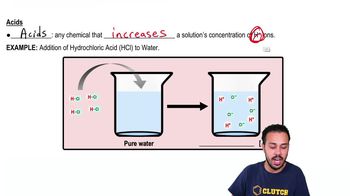
Acid Rain
 02:45
02:45
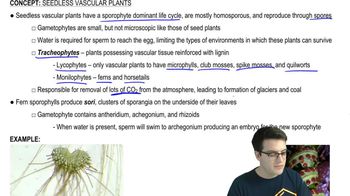
Vascular Cambium
 06:08
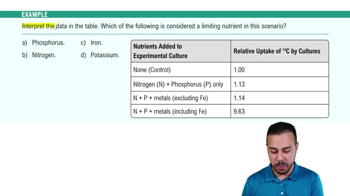
06:08Impact on Wood Production
 02:31
02:31Plants experience a vast array of conditions that can alter their growth and development, including temperature and availability of water, nutrients, and light. They are also exposed to pollutants such as acid rain formed largely as a result of burning fossil fuels and volcanic eruptions. Acid rain can strip minerals and nutrients from the soil, and eat away the outer waxy layer of tissue that protects a plant. Acid rain is still a major environmental problem in certain regions. How does acid rain affect plant growth? Which meristem was likely affected in the chinaberry tree?
Plants experience a vast array of conditions that can alter their growth and development, including temperature and availability of water, nutrients, and light. They are also exposed to pollutants such as acid rain formed largely as a result of burning fossil fuels and volcanic eruptions. Acid rain can strip minerals and nutrients from the soil, and eat away the outer waxy layer of tissue that protects a plant. Acid rain is still a major environmental problem in certain regions. How does acid rain affect plant growth? Give a plausible explanation for the differential effect of acid rain on height in camphor and chinaberry trees (i.e., what structural features might offer more protection from acid rain in one species versus another?).
Plants experience a vast array of conditions that can alter their growth and development, including temperature and availability of water, nutrients, and light. They are also exposed to pollutants such as acid rain formed largely as a result of burning fossil fuels and volcanic eruptions. Acid rain can strip minerals and nutrients from the soil and eat away the outer waxy layer of tissue that protects a plant. Acid rain is still a major environmental problem in certain regions. How does acid rain affect plant growth?
Beyond primary and secondary growth, what other aspects of plant growth might be negatively affected when plants are exposed to environmental stress?