Pearson+ LogoPearson+ Logo
Ch. 26 - Bacteria and Archaea
Freeman - Biological Science 8th Edition
Freeman8th EditionBiological ScienceISBN: 9780138276263Not the one you use?Change textbook
Chapter 26, Problem 5

What has metagenomic analysis allowed researchers to do for the first time? a. sample organisms from an environment and grow them under defined conditions in the lab b. isolate organisms from an environment and sequence their entire genome c. study organisms that cannot be cultured (grown in the lab) d. identify important morphological differences among species

Verified step by step guidance
1
Understand the term 'metagenomic analysis': Metagenomic analysis is a technique that involves the direct genetic analysis of genomes contained within an environmental sample.
Recognize the significance of metagenomics: This method allows researchers to study the genetic material of entire communities of organisms, rather than individual species.
Identify the unique capability of metagenomics: Unlike traditional methods, metagenomics does not require culturing organisms in the lab, which is often difficult or impossible for many microbes.
Relate the options to metagenomic capabilities: Option c, 'study organisms that cannot be cultured (grown in the lab),' directly reflects the unique advantage of metagenomic analysis.
Conclude the correct answer: The correct answer is c, as metagenomic analysis specifically allows researchers to study organisms that cannot be cultured in the lab, which was not possible with previous techniques.

Verified video answer for a similar problem:

This video solution was recommended by our tutors as helpful for the problem above.
Video duration:
29s
Was this helpful?

Key Concepts

Here are the essential concepts you must grasp in order to answer the question correctly.

Metagenomics

Metagenomics is the study of genetic material recovered directly from environmental samples. This approach allows researchers to analyze the collective genomes of microorganisms in a specific habitat, providing insights into the diversity and functions of microbial communities without the need for culturing individual species.

Culture-Independent Methods

Culture-independent methods refer to techniques that allow scientists to study organisms without the necessity of growing them in laboratory conditions. This is particularly important for microorganisms that are difficult or impossible to culture, enabling researchers to explore the full range of biodiversity present in various environments.
Recommended video:
Guided course
06:29
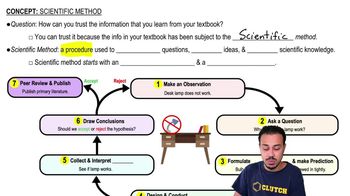
Scientific Method

Genomic Sequencing

Genomic sequencing is the process of determining the complete DNA sequence of an organism's genome. In the context of metagenomics, it allows for the identification and characterization of all the genetic material present in a sample, facilitating the study of complex microbial communities and their interactions within ecosystems.
Recommended video:
Guided course
05:30
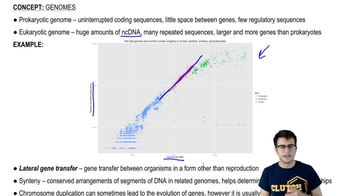
Genomes and Genome Evolution
Related Practice
Textbook Question

What are organisms called that use inorganic compounds as electron donors in cellular respiration?

a. Phototrophs

b. Heterotrophs

c. Organotrophs

d. Lithotrophs

Textbook Question

Unlike plant cell walls that contain cellulose, bacterial cell walls are composed of ___________.

1
views
Textbook Question

Evaluate these statements about Koch's postulates, which are used to establish a causative link between a specific microbe and a specific disease. Select True or False for each statement.

T/FThe microbe must be present in individuals suffering from the disease and absent from healthy individuals.

T/FThe microbe must be isolated and grown in pure culture.

T/FIf organisms from the pure culture are injected into a healthy experimental animal, the disease symptoms should appear.

T/FThe microbe does not have to be isolated from the experimental animal as long as the disease is present.

Textbook Question

Biologists often use the term 'energy source' as a synonym for 'electron donor.' Why?

Textbook Question

The text claims that the evolution of an oxygen-rich atmosphere paved the way for increasingly efficient cellular respiration and higher growth rates in organisms. Explain.

1
views
Textbook Question

Streptococcus mutans obtains energy by oxidizing sucrose. This bacterium is abundant in the mouths of Western European and North American children and is a prominent cause of cavities. The organism is virtually absent in children from East Africa, where tooth decay is rare. Propose a hypothesis to explain this observation. Outline the design of a study that would test your hypothesis.