
Pearson+ LogoPearson+ Logo
Ch. 15 - DNA and the Gene: Synthesis and Repair
Freeman - Biological Science 8th Edition
Freeman8th EditionBiological ScienceISBN: 9780138276263Not the one you use?Change textbook
Chapter 15, Problem 8b

What aspect of DNA structure makes it possible for the proteins of nucleotide excision repair to recognize many different types of DNA damage?
(b) the antiparallel orientation of strands in the double helix

Verified step by step guidance
1
Understand the structure of DNA: DNA is composed of two strands that form a double helix. Each strand is made up of nucleotides, which include a phosphate group, a sugar molecule (deoxyribose), and a nitrogenous base (adenine, thymine, cytosine, or guanine).
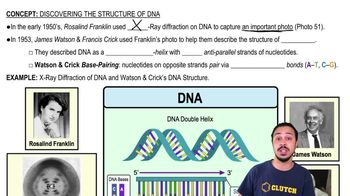
Recognize the antiparallel orientation: In the double helix, the two strands run in opposite directions, meaning one strand runs 5' to 3' and the other runs 3' to 5'. This orientation is crucial for the replication and repair processes.
Identify the role of nucleotide excision repair: This repair mechanism is responsible for detecting and removing damaged nucleotides, such as those caused by UV light or chemical exposure, and replacing them with the correct nucleotides.
Explore how proteins recognize DNA damage: Proteins involved in nucleotide excision repair can identify distortions in the DNA helix caused by damage. The antiparallel orientation allows these proteins to scan both strands effectively, recognizing a wide variety of damage types.
Consider the flexibility of the DNA structure: The double helix can undergo local unwinding or bending, which helps repair proteins access and recognize damaged sites. The antiparallel nature ensures that the repair machinery can operate efficiently across different types of damage.

Verified video answer for a similar problem:

This video solution was recommended by our tutors as helpful for the problem above.
Video duration:
43s
Was this helpful?

Key Concepts

Here are the essential concepts you must grasp in order to answer the question correctly.

DNA Structure

DNA is composed of two strands forming a double helix, with each strand consisting of nucleotides. The structure is stabilized by hydrogen bonds between complementary bases (adenine-thymine and guanine-cytosine). This configuration allows for the recognition and repair of damaged sites by repair proteins, as any deviation from the normal base pairing can be detected.
Recommended video:
Guided course
04:41
Discovering the Structure of DNA

Antiparallel Orientation

The antiparallel orientation refers to the opposite directional alignment of the two DNA strands, where one strand runs 5' to 3' and the other 3' to 5'. This orientation is crucial for replication and repair processes, as it ensures that enzymes and repair proteins can access and interact with the DNA in a consistent manner, facilitating the recognition of structural anomalies.
Recommended video:
Guided course
04:41
Discovering the Structure of DNA

Nucleotide Excision Repair

Nucleotide excision repair is a DNA repair mechanism that identifies and removes damaged nucleotides, particularly those causing distortions in the DNA helix. This process involves several proteins that scan the DNA for irregularities, excise the damaged section, and fill in the gap with the correct nucleotides, maintaining genomic integrity.
Recommended video:
Related Practice
Textbook Question

Analyze the following statements about DNA synthesis. Select True or False for each statement.

T/FAn RNA polymerase is essential for DNA synthesis.

T/FOkazaki fragments would be unnecessary if DNA polymerase could synthesize DNA in both the 3'→5' and 5'→3' directions.

T/FDNA ligase is used more frequently on the lagging strand than on the leading strand.

T/FToposiomerase is required to separate the two strands of DNA at the replication fork.

Textbook Question

How does telomerase prevent linear chromosomes from shortening during replication?

Textbook Question

What aspect of DNA structure makes it possible for the proteins of nucleotide excision repair to recognize many different types of DNA damage?

(a) the polarity of each DNA strand

Textbook Question

What aspect of DNA structure makes it possible for the proteins of nucleotide excision repair to recognize many different types of DNA damage?

(c) the energy differences between correct and incorrect base pairs

Textbook Question

What aspect of DNA structure makes it possible for the proteins of nucleotide excision repair to recognize many different types of DNA damage?

(d) the regularity of DNA's structure

Textbook Question

In the late 1950s, Herbert Taylor grew bean root-tip cells in a solution of radioactive thymidine (a precursor to one of the deoxyribonucleotides in DNA) and allowed them to undergo one round of DNA replication. He then transferred the cells to a solution without radioactive thymidine, allowed them to replicate again, and examined their chromosomes for the presence of radioactivity. His results are shown in the following figure, where red indicates a radioactive chromatid.

(b) What would the results of Taylor's experiment be if eukaryotes used a conservative mode of DNA replication?