
Textbook Question
Researchers design experiments so that only one thing is different between the treatments that are being compared. In the Hershey–Chase experiment, what was this single difference?
1
views
 Verified step by step guidance
 04:41
04:41
 03:20
03:20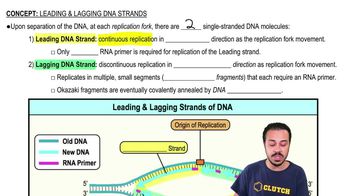 05:15
05:15Researchers design experiments so that only one thing is different between the treatments that are being compared. In the Hershey–Chase experiment, what was this single difference?
Analyze the following statements about DNA synthesis. Select True or False for each statement.
T/FAn RNA polymerase is essential for DNA synthesis.
T/FOkazaki fragments would be unnecessary if DNA polymerase could synthesize DNA in both the 3'→5' and 5'→3' directions.
T/FDNA ligase is used more frequently on the lagging strand than on the leading strand.
T/FToposiomerase is required to separate the two strands of DNA at the replication fork.
How does telomerase prevent linear chromosomes from shortening during replication?
What aspect of DNA structure makes it possible for the proteins of nucleotide excision repair to recognize many different types of DNA damage?
(b) the antiparallel orientation of strands in the double helix
What aspect of DNA structure makes it possible for the proteins of nucleotide excision repair to recognize many different types of DNA damage?
(c) the energy differences between correct and incorrect base pairs
What aspect of DNA structure makes it possible for the proteins of nucleotide excision repair to recognize many different types of DNA damage?
(d) the regularity of DNA's structure