Back
Back
Problem 1
Restriction enzymes were first discovered with the observation that
a. DNA is restricted to the nucleus.
b. Bacteriophage DNA is destroyed in a host cell.
c. Foreign DNA is kept out of a cell.
d. Foreign DNA is restricted to the cytoplasm.
e. All of the above.
Problem 1
Compare and contrast the following terms:
a. cDNA and gene
b. DNA probe and gene
c. DNA polymerase and DNA ligase
d. rDNA and cDNA
e. genome and proteome
Problem 2
Differentiate the following terms. Which one is “hit and miss”—that is, does not add a specific gene to a cell?
a. Protoplast fusion
b. Gene gun
c. Microinjection
d. Electroporation
Problem 2
The DNA probe, 3'-GGCTTA, will hybridize with which of the following?
a. 5'-CCGUUA
b. 5'-CCGAAT
c. 5'-GGCTTA
d. 3'-CCGAAT
e. 3'-GGCAAU
Problem 3
Some commonly used restriction enzymes are listed in Table 9.1.
a. Indicate which enzymes produce sticky ends.
b. Of what value are sticky ends in making rDNA?
Problem 3
Which of the following is the fourth basic step to genetically modify a cell?
a. Transformation
b. Ligation
c. Plasmid cleavage
d. Restriction-enzyme digestion of gene
e. Isolation of gene
Problem 4
The following enzymes are used to make cDNA. What is the second enzyme used to make cDNA?
a. Reverse transcriptase
b. Ribozyme
c. RNA polymerase
d. DNA polymerase
Problem 4
Suppose you want multiple copies of a gene you have synthesized. How would you obtain the necessary copies by cloning? By PCR?
Problem 5
If you put a gene in a virus, the next step in genetic modification would be
a. insertion of a plasmid.
b. transformation.
c. transduction.
d. PCR.
e. Southern blotting.
Problem 5
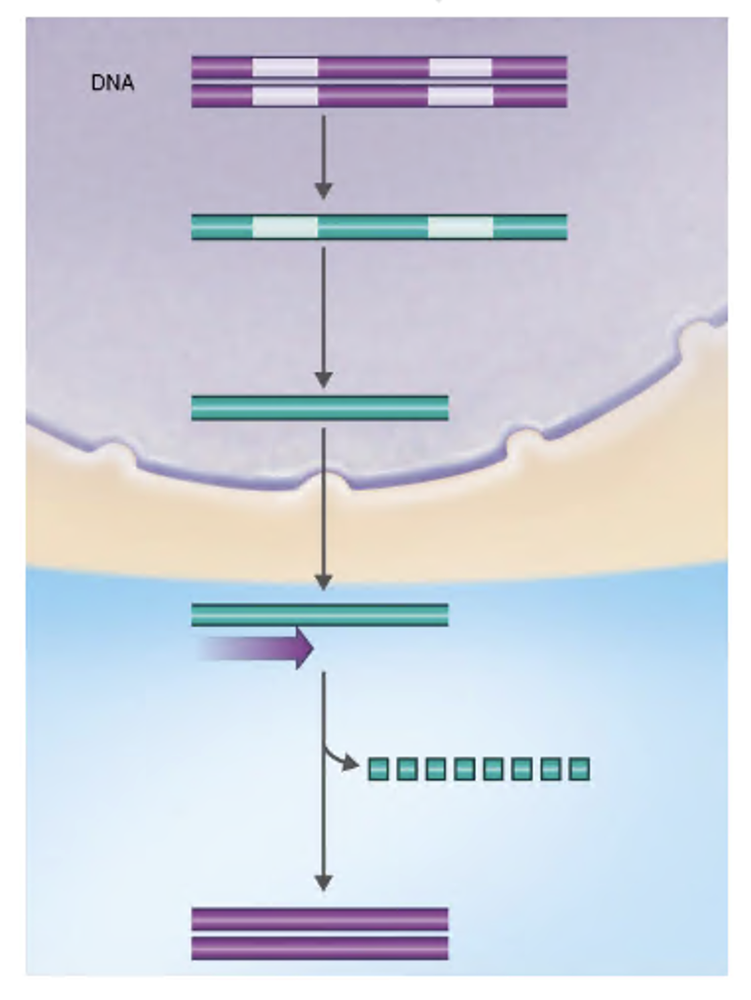
Identify and mark each of the following in making cDNA: transcription, RNA processing, reverse transcription, DNA polymerase, cDNA.
Problem 6
You have a small gene that you want replicated by PCR. You add fluorescent dye-labeled nucleotides to the PCR thermal cycler. After three replication cycles, what percentage of the DNA single strands will fluoresce?
a. 0%
b. 12.5%
c. 50%
d. 87.5%
e. 100%
Problem 6
Describe an rDNA experiment in two or three sentences. Use the following terms: intron, exon, DNA, mRNA, cDNA, RNA polymerase, reverse transcriptase.
Problem 7
Pieces of human DNA stored in yeast cells.
a. Antisense
b. Clone
c. Library
d. Southern blot
e. Vector
Problem 7
List at least two examples of the use of rDNA in medicine and in agriculture.
Problem 8
A population of cells carrying a desired plasmid.
a. Antisense
b. Clone
c. Library
d. Southern blot
e. Vector
Problem 8
You are attempting to insert a gene for saltwater tolerance into a plant by using the Ti plasmid. In addition to the desired gene, you add a gene for tetracycline resistance (tet) to the plasmid. What is the purpose of the tet gene?
Problem 9
Self-replicating DNA for transmitting a gene from one organism to another.
a. Antisense
b. Clone
c. Library
d. Southern blot
e. Vector
Problem 9
How does RNAi “silence” a gene?
Problem 10
Match the following choices to the statement provided below.
a. Antisense
b. Clone
c. Library
d. Southern blot
e. Vector
DNA that hybridizes with mRNA.
Problem 10
This virus family, normally associated with AIDS, may be useful for gene therapy.