Back
Back
Problem 1
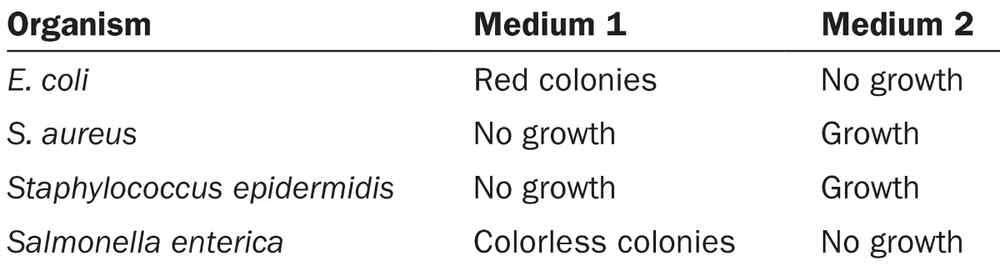
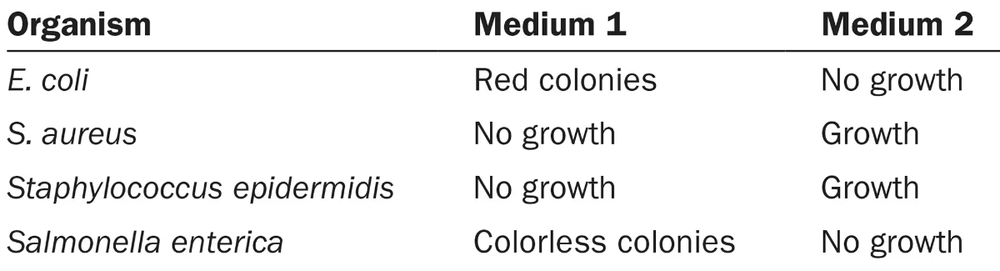
Use the following information to answer questions 1 and 2. Two culture media were inoculated with four different bacteria. After incubation, the following results were obtained:
Medium 1 is
a. Selective
b. Differential
c. Both selective and differential
Problem 1
Describe binary fission.
Problem 2
Macronutrients (needed in relatively large amounts) are often listed as CHONPS. What does each of these letters indicate, and why are they needed by the cell?
Problem 3
Define and explain the importance of each of the following:
a. Catalase
b. Hydrogen peroxide
c. Peroxidase
d. Superoxide radical
e. Superoxide dismutase
Problem 3
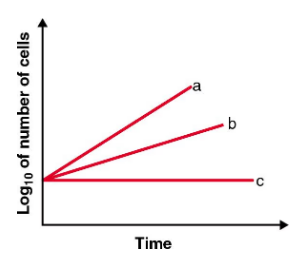
Which of the lines best depicts the log phase of a thermophile incubated at room temperature?
Problem 4
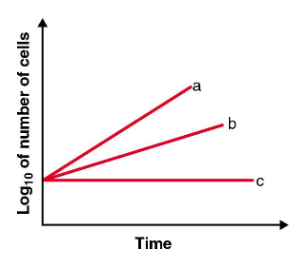
Which of the lines best depicts the log phase of Listeria monocytogenes growing in a human?
Problem 4
Seven methods of measuring microbial growth were explained in this chapter. Categorize each as either a direct or an indirect method.
Problem 5
Assume you inoculated 100 facultatively anaerobic cells onto nutrient agar and incubated the plate aerobically. You then inoculated 100 cells of the same species onto nutrient agar and incubated the second plate anaerobically. After incubation for 24 hours, you should have
a. more colonies on the aerobic plate.
b. more colonies on the anaerobic plate.
c. the same number of colonies on both plates.
Problem 5
By deep-freezing, bacteria can be stored without harm for extended periods. Why do refrigeration and freezing preserve foods?
Problem 6
A pastry chef accidentally inoculated a cream pie with six S. aureus cells. If S. aureus has a generation time of 60 minutes, how many cells would be in the cream pie after 7 hours?
Problem 6
The term trace elements refers to
a. The elements CHONPS.
b. Vitamins.
c. Nitrogen, phosphorus, and sulfur.
d. Small mineral requirements.
e. Toxic substances.
Problem 6.2a
Use the following information to answer questions 1 and 2. Two culture media were inoculated with four different bacteria. After incubation, the following results were obtained:
Medium 2 is:
a. Selective
b. Differential
c. Both selective and differential
Problem 7
Which one of the following temperatures would most likely kill a mesophile?
a. -50℃
b. 0℃
c. 9℃
d. 37℃
e. 60℃
Problem 7
Nitrogen and phosphorus added to beaches following an oil spill encourage the growth of natural oil-degrading bacteria. Explain why the bacteria do not grow if nitrogen and phosphorus are not added.
Problem 8
Differentiate complex and chemically defined media.
Problem 8
Which of the following is not a characteristic of biofilms?
a. Antibiotic resistance
b. Hydrogel
c. Iron deficiency
d. Quorum sensing
Problem 9
Which of the following types of media would not be used to culture aerobes?
a. Selective media
b. Reducing media
c. Enrichment media
d. Differential media
e. Complex media
Problem 9
Which of the following is true about the optimum growth temperature of most mesophiles?
a) They can grow well at 37^0C.
b) They are more likely to grow at refrigerator temperatures.
c) They can strive well in extremely high temperatures.
d) All of the above.
Problem 10
An organism that has peroxidase and superoxide dismutase but lacks catalase is most likely an
a. aerobe.
b. aerotolerant anaerobe.
c. obligate anaerobe.
Problem 10
A prokaryotic cell hitched a ride to Earth on a space shuttle from some unknown planet. The organism is a psychrophile, an obligate halophile, and an obligate aerobe. Based on the characteristics of the microbe, describe the planet.