Back
Back
Problem 10
____________________ is a recombination event that occurs during gamete formation in eukaryotes.
Problem 10
Which of the following methods of DNA repair involves enzymes that recognize and correct nucleotide errors in unmethylated strands of DNA?
a. Light repair of T dimers
b. Dark repair of P dimers
c. Mismatch repair
d. SOS response
Problem 10
Explain the central dogma of genetics.
Problem 11
Which of the following is not a mechanism of genetic transfer between cells?
a. Transduction
b. Transformation
c. Transcription
d. Conjugation
Problem 11
__________ RNA carries amino acids.
Problem 11
Compare and contrast the processes of transformation, transduction, and conjugation.
Problem 12
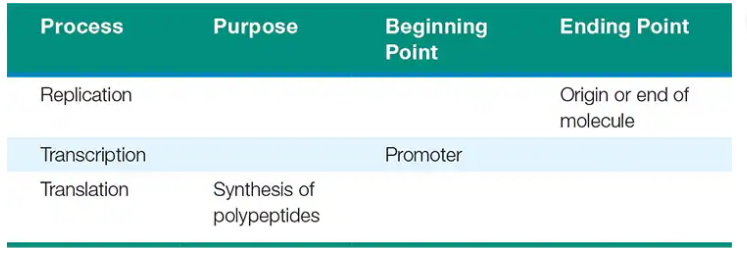
Fill in the following table:
Problem 12
Cells that have the ability to take up DNA from their environment are said to be ___________.
a. Hfr cells
b. transposing
c. genomic
d. competent
Problem 12
__________ RNA and __________ RNA are antisense; that is, they are complementary to another nucleic acid molecule.
Problem 13
Which of the following statements is true?
a. Conjugation requires a sex pilus extending from the surface of a cell.
b. Conjugation involves a C factor.
c. Conjugation is an artificial genetic engineering technique.
d. Conjugation involves DNA that has been released into the environment.
Problem 14
Which of the following are called “jumping genes”?
a. Hfr cells
b. Transducing phages
c. Palindromic sequences
d. Transposons
Problem 15
Although two cells are totally unrelated, one cell receives DNA from the other cell and incorporates this new DNA into its chromosome. This process is ___________.
a. crossing over of DNA from the two cells
b. vertical gene transfer
c. horizontal gene transfer
d. transposition
Problem 16
Transcription produces:
a. DNA molecules
b. RNA molecules
c. Polypeptides
d. Palindromes
Problem 17
A nucleotide is made of:
a. A five-carbon sugar
b. Phosphate
c. A nitrogenous base
d. All of the above
Problem 19
A sequence of nucleotides formed during replication of the lagging DNA strand is a(n):
a. Palindrome
b. Okazaki fragment
c. Coding strand
d. Operon
Problem 20
Which of the following is not part of an operon?
a. Operator
b. Promoter
c. Origin
d. Gene
Problem 21
Repressible operons are important in regulating prokaryotic:
a. DNA replication
b. RNA transcription
c. rRNA processing
d. Sugar catabolism
Problem 22
Which of the following is part of each molecule of mRNA?
a. Palindrome
b. Codon
c. Anticodon
d. Base pair
Problem 23
Ligase plays a major role in:
a. Replication of lagging strands
b. mRNA processing in eukaryotes
c. Polypeptide synthesis by ribosomes
d. RNA transcription
Problem 24
Before mutations can affect a population permanently, they must be __________ .
a. lasting
b. inheritable
c. beneficial
d. all of the above
Problem 25
The trp operon is repressible. This means it is usually __________ and is directly controlled by a(n) ___________ .
a. active / inducer
b. active / repressor
c. inactive / inducer
d. inactive /repressor