Back
Back
Problem 1
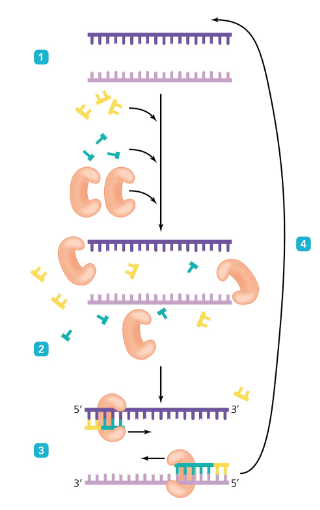
Label the reagents and steps of PCR on the following figure. Indicate the temperature of the reaction at each numbered step.
Problem 1
Describe three artificial methods of introducing DNA into cells.
Problem 1
Which of the following statements is true concerning recombinant DNA technology?
a. It will replace biotechnology in the future.
b. It is a single technique for genetic manipulation.
c. It is useful in manipulating genotypes but not phenotypes.
d. It involves modification of an organism’s genome.
Problem 1
Indicate which of the following are true and which are false. Rewrite any false statements to make them true by changing the underlined words.
__________ Restriction enzymes inhibit the movement of DNA at specific sites.
Problem 2
Why is cloning a practical technique for medical researchers?
Problem 2
A DNA gene synthesized from an RNA template is ___________ .
a. reverse transcriptase
b. complementary DNA
c. recombinant DNA
d. probe DNA
Problem 2
Indicate which of the following are true and which are false. Rewrite any false statements to make them true by changing the underlined words.
__________ Restriction enzymes act at specific nucleotide sequences within a double-stranded DNA molecule.
Problem 3
Indicate which of the following are true and which are false. Rewrite any false statements to make them true by changing the underlined words.
__________ A thermocycler separates molecules based on their size, shape, and electrical charge.
Problem 3
Describe three ways scientists use synthetic nucleic acids.
Problem 3
After scientists exposed cultures of Penicillium to agents X, Y, and Z, they examined the type and amount of penicillin produced by the altered fungi to find the one that is most effective. Agents X, Y, and Z were probably __________ .
a. recombinant cells
b. competent
c. mutagens
d. phages
Problem 4
Indicate which of the following are true and which are false. Rewrite any false statements to make them true by changing the underlined words.
__________ Protoplast fusion is often used in the genetic modification of plants.
Problem 4
Which of the following is false concerning vectors in recombinant DNA technology?
a. Vectors are small enough to manipulate outside a cell.
b. Vectors contain a recognizable genetic marker.
c. Vectors survive inside cells.
d. Vectors must contain genes for self-replication.
Problem 4
Describe a CRISPR system and its usefulness.
Problem 5
List three potential problems of recombinant DNA technology.
Problem 5
Indicate which of the following are true and which are false. Rewrite any false statements to make them true by changing the underlined words.
__________ Gel electrophoresis is used in DNA microarrays.
Problem 5
Which recombinant DNA technique is used to replicate copies of a DNA molecule?
a. PCR
b. Gel electrophoresis
c. Electroporation
d. Reverse transcription
Problem 6
Which of the following would be most useful in following gene expression in a yeast cell?
a. Southern blot
b. PCR
c. DNA microarray
d. Restriction enzymes
Problem 7
Which of the following techniques is used regularly in the study of genomics?
a. Clones are selected using a vector with two genetic markers.
b. Genes are inserted to produce an antigenic protein from a pathogen.
c. Fluorescent nucleotide bases are sequenced.
d. Defective organs are replaced with those made in animal hosts.
Problem 8
The CRISPR-associated enzyme Cas9 __________ .
a. cuts RNA at a specific nucleotide sequence
b. cuts DNA at a specific nucleotide sequence
c. is likely derived from a bacteriophage
d. All of the above are correct.
Problem 9
Which application of recombinant DNA technology involves replacing a nonfunctional, mutated gene with a functional gene?
a. Gene therapy
b. Functional genomics
c. Genetic screening
d. Protein synthesis
Problem 10
A DNA microarray consists of __________ .
a. a series of clones containing the entire genome of a microbe
b. recombinant microbial cells
c. restriction enzyme fragments of DNA molecules
d. single-stranded DNA localized on a substrate