Pearson+ LogoPearson+ Logo
Ch.18 Metabolic Pathways and ATP Production
Timberlake - Chemistry: An Introduction to General, Organic, and Biological Chemistry 14th Edition
Timberlake14thChemistry: An Introduction to General, Organic, and Biological ChemistryISBN: 9781292472249Not the one you use?Change textbook
Chapter 18, Problem 42b

Refer to the diagram of the citric acid cycle in Figure 18.13 to answer each of the following:
b. What are the four-carbon compounds?

Verified step by step guidance
1
Step 1: Begin by understanding the citric acid cycle (also known as the Krebs cycle or TCA cycle). It is a series of chemical reactions used by all aerobic organisms to release stored energy through the oxidation of acetyl-CoA derived from carbohydrates, fats, and proteins.
Step 2: Refer to Figure 18.13 of the citric acid cycle diagram. Identify the compounds involved in the cycle, paying close attention to the molecular structures and carbon counts of each compound.
Step 3: Focus on the compounds that have four carbon atoms. These are intermediates in the cycle and play a key role in the transfer of energy and electrons.
Step 4: Note that the four-carbon compounds in the citric acid cycle include oxaloacetate, succinate, fumarate, and malate. These compounds are involved in different steps of the cycle, such as regeneration of oxaloacetate and conversion of succinate to fumarate.
Step 5: Understand the role of these four-carbon compounds in the cycle. For example, oxaloacetate combines with acetyl-CoA to form citrate, and fumarate is formed during the oxidation of succinate. This helps in understanding the flow of carbon atoms and energy within the cycle.

Verified video answer for a similar problem:

This video solution was recommended by our tutors as helpful for the problem above.
Video duration:
1m
Was this helpful?

Key Concepts

Here are the essential concepts you must grasp in order to answer the question correctly.

Citric Acid Cycle

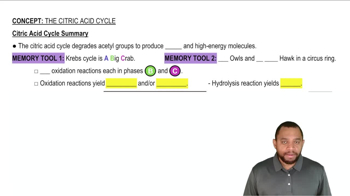
The citric acid cycle, also known as the Krebs cycle, is a key metabolic pathway that takes place in the mitochondria. It involves a series of chemical reactions used by all aerobic organisms to generate energy through the oxidation of acetyl-CoA derived from carbohydrates, fats, and proteins. The cycle produces energy-rich molecules such as ATP, NADH, and FADH2, which are essential for cellular respiration.
Recommended video:
Guided course
2:31
Citric Acid Cycle Summary Concept 12

Four-Carbon Compounds

In the context of the citric acid cycle, four-carbon compounds play a crucial role in the cycle's progression. Notable four-carbon intermediates include succinate and oxaloacetate. These compounds are involved in various steps of the cycle, facilitating the conversion of energy and the regeneration of the cycle's starting material, which is essential for continuous operation.
Recommended video:
Guided course
02:11
Naming Ionic Compounds

Metabolic Intermediates

Metabolic intermediates are the various compounds formed during the metabolic pathways, including the citric acid cycle. They serve as substrates for subsequent reactions and are vital for the regulation of metabolic processes. Understanding these intermediates, such as the four-carbon compounds, helps in grasping how energy is produced and utilized in cellular metabolism.
Recommended video:
Guided course
0:52
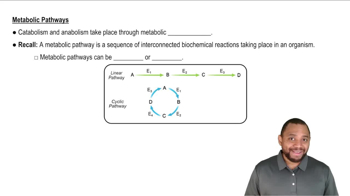
Metabolic Pathways Concept 2