Pearson+ LogoPearson+ Logo
Ch.16 Amino Acids, Proteins, and Enzymes
Timberlake - Chemistry: An Introduction to General, Organic, and Biological Chemistry 14th Edition
Timberlake14thChemistry: An Introduction to General, Organic, and Biological ChemistryISBN: 9781292472249Not the one you use?Change textbook
Chapter 16, Problem 22d

What type of interaction would you expect between the R groups of the following amino acids in a quaternary structure?
d. alanine and proline

Verified step by step guidance
1
Identify the R groups of the amino acids alanine and proline. Alanine has a nonpolar methyl group (-CH₃) as its R group, while proline has a nonpolar cyclic structure (a pyrrolidine ring) as its R group.
Recognize that both alanine and proline have nonpolar R groups. Nonpolar groups tend to interact through hydrophobic interactions in a protein's quaternary structure.
Understand that hydrophobic interactions occur when nonpolar groups cluster together to avoid contact with water, stabilizing the protein's structure.
Conclude that the interaction between the R groups of alanine and proline in a quaternary structure would primarily involve hydrophobic interactions.
Note that these interactions contribute to the overall stability of the protein's quaternary structure by minimizing the exposure of nonpolar groups to the aqueous environment.

Verified video answer for a similar problem:

This video solution was recommended by our tutors as helpful for the problem above.
Video duration:
1m
Was this helpful?

Key Concepts

Here are the essential concepts you must grasp in order to answer the question correctly.

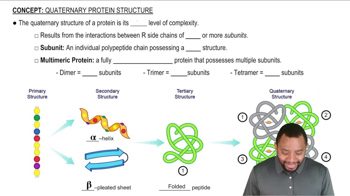
Quaternary Structure of Proteins

Quaternary structure refers to the complex formation of multiple polypeptide chains (subunits) that come together to form a functional protein. This level of structure is stabilized by various interactions between the R groups of the amino acids in the subunits, which can include hydrogen bonds, ionic bonds, hydrophobic interactions, and van der Waals forces.
Recommended video:
Guided course
3:26
Quaternary Protein Structure Concept 1

R Groups of Amino Acids

The R group, or side chain, of an amino acid determines its unique properties and interactions. In the case of alanine, which has a nonpolar, hydrophobic side chain, and proline, which has a unique cyclic structure that introduces rigidity, their interactions in a quaternary structure can influence the overall stability and conformation of the protein.
Recommended video:
Guided course
2:21
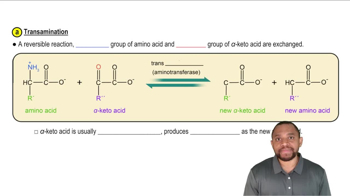
Amino Acid Catabolism: Amino Group Concept 2

Hydrophobic and Hydrophilic Interactions

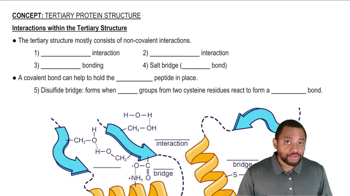
Hydrophobic interactions occur when nonpolar R groups, like that of alanine, cluster together to avoid contact with water, while hydrophilic interactions involve polar or charged R groups that can form hydrogen bonds with water. In a quaternary structure, the arrangement of these interactions is crucial for maintaining the protein's stability and functionality, influencing how alanine and proline interact.
Recommended video:
Guided course
2:41
Interactions within the Tertiary Structure Concept 2