Pearson+ LogoPearson+ Logo
Ch.14 Carboxylic Acids, Esters, Amines, and Amides
Timberlake - Chemistry: An Introduction to General, Organic, and Biological Chemistry 14th Edition
Timberlake14thChemistry: An Introduction to General, Organic, and Biological ChemistryISBN: 9781292472249Not the one you use?Change textbook
Chapter 14, Problem 12b

Write the balanced chemical equation for the reaction of each of the following carboxylic acids with KOH:
b. 2-methylbutanoic acid

Verified step by step guidance
1
Identify the chemical formula of 2-methylbutanoic acid. The structure consists of a carboxylic acid group (-COOH) attached to a 2-methylbutane backbone. Its molecular formula is C5H10O2.
Write the general reaction for a carboxylic acid reacting with a base (KOH). Carboxylic acids react with bases to form water and a salt. The reaction can be expressed as: \( \text{R-COOH} + \text{KOH} \rightarrow \text{R-COOK} + \text{H}_2\text{O} \).
Substitute the specific formula of 2-methylbutanoic acid (C5H10O2) into the reaction. The carboxylic acid group reacts with KOH to form potassium 2-methylbutanoate (C5H9O2K) and water (H2O).
Ensure the equation is balanced. Verify that the number of atoms of each element is the same on both sides of the equation. For this reaction, the equation is already balanced as written.
Write the final balanced chemical equation: \( \text{C}_5\text{H}_{10}\text{O}_2 + \text{KOH} \rightarrow \text{C}_5\text{H}_9\text{O}_2\text{K} + \text{H}_2\text{O} \).

Verified video answer for a similar problem:

This video solution was recommended by our tutors as helpful for the problem above.
Video duration:
2m
Was this helpful?

Key Concepts

Here are the essential concepts you must grasp in order to answer the question correctly.

Carboxylic Acids

Carboxylic acids are organic compounds characterized by the presence of one or more carboxyl groups (-COOH). They are known for their acidic properties due to the ability of the carboxyl group to donate a proton (H+) in solution. Understanding the structure and reactivity of carboxylic acids is essential for predicting their behavior in chemical reactions, such as neutralization with bases like KOH.
Recommended video:
Guided course
1:09
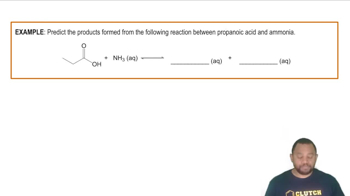
Carboxylic Acid Reactions Example 1

Neutralization Reaction

A neutralization reaction occurs when an acid reacts with a base to produce water and a salt. In this context, the carboxylic acid (2-methylbutanoic acid) reacts with potassium hydroxide (KOH), a strong base, resulting in the formation of potassium 2-methylbutanoate and water. This concept is fundamental for balancing chemical equations, as it involves understanding the stoichiometry of the reactants and products.
Recommended video:
Guided course
00:37
Lewis Dot Structures: Neutral Compounds (Simplified) Concept 1

Balancing Chemical Equations

Balancing chemical equations is the process of ensuring that the number of atoms for each element is the same on both sides of the equation. This is crucial for accurately representing the conservation of mass in a chemical reaction. In the case of the reaction between 2-methylbutanoic acid and KOH, one must account for all atoms involved to write a correct and balanced equation, reflecting the stoichiometric relationships between reactants and products.
Recommended video:
Guided course
01:32
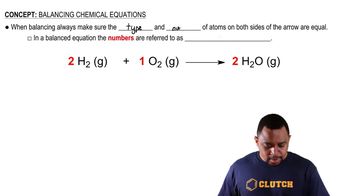
Balancing Chemical Equations (Simplified) Concept 1