Pearson+ LogoPearson+ Logo
Ch.11 Introduction to Organic Chemistry: Hydrocarbons
Timberlake - Chemistry: An Introduction to General, Organic, and Biological Chemistry 14th Edition
Timberlake14thChemistry: An Introduction to General, Organic, and Biological ChemistryISBN: 9781292472249Not the one you use?Change textbook
Chapter 11, Problem 5b

Match each of the following physical and chemical properties with ethane, C2H6 or sodium bromide, NaBr:
b. burns vigorously in air

Verified step by step guidance
1
Step 1: Understand the difference between physical and chemical properties. A chemical property describes a substance's ability to undergo a chemical change, such as burning or reacting with another substance. A physical property, on the other hand, can be observed without changing the substance's chemical identity.
Step 2: Analyze the property described in the problem: 'burns vigorously in air.' This refers to a substance's ability to react with oxygen in the air, which is a chemical reaction known as combustion.
Step 3: Recall the chemical nature of ethane (C₂H₆). Ethane is a hydrocarbon, and hydrocarbons are known to combust in the presence of oxygen, producing carbon dioxide and water. This makes 'burns vigorously in air' a chemical property of ethane.
Step 4: Consider sodium bromide (NaBr). Sodium bromide is an ionic compound and does not combust in air. It does not exhibit the property of burning vigorously in air.
Step 5: Conclude that the property 'burns vigorously in air' matches ethane (C₂H₆), as it is a chemical property associated with hydrocarbons like ethane.

Verified video answer for a similar problem:

This video solution was recommended by our tutors as helpful for the problem above.
Was this helpful?

Key Concepts

Here are the essential concepts you must grasp in order to answer the question correctly.

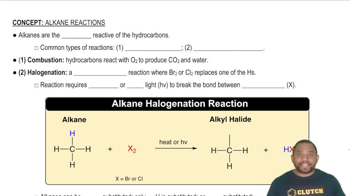
Combustion

Combustion is a chemical reaction that occurs when a substance reacts rapidly with oxygen, producing heat and light. In the context of ethane (C₂H₆), it burns vigorously in air, releasing energy and forming carbon dioxide and water. This property is essential for understanding the reactivity of hydrocarbons and their use as fuels.
Recommended video:
Guided course
2:25
Common Types of Alkane Reactions Concept 1

Physical Properties

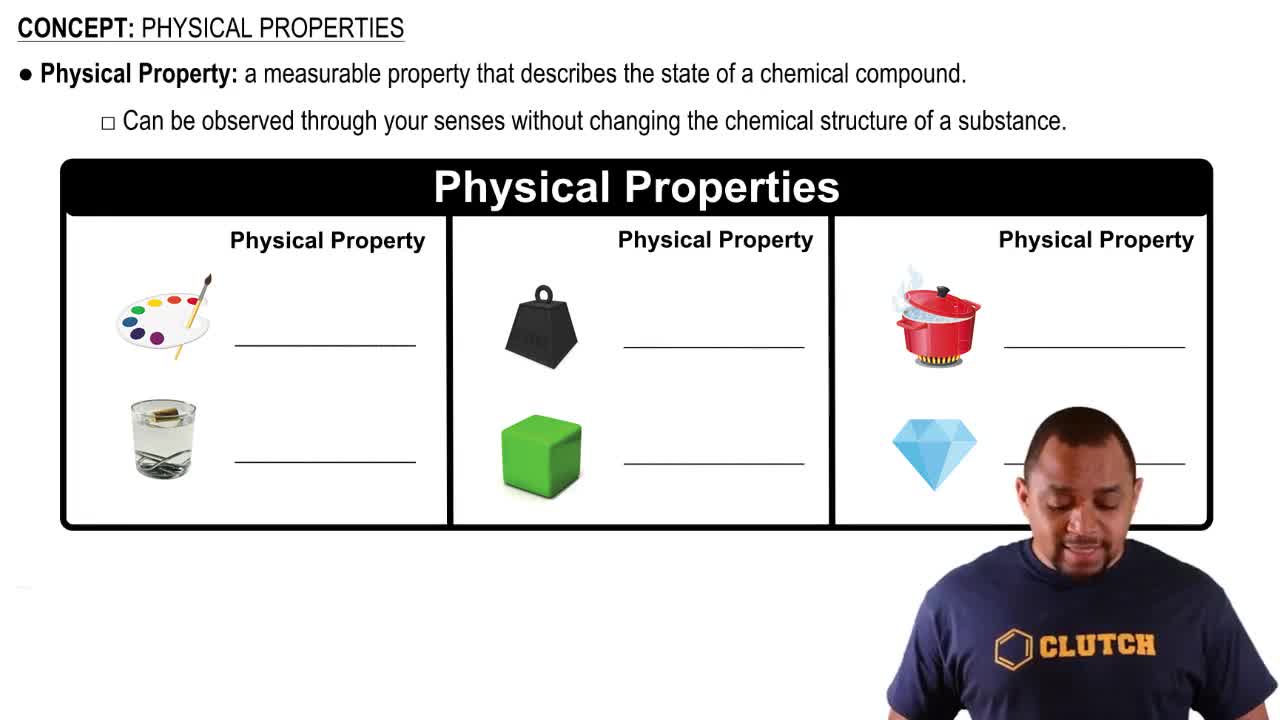
Physical properties are characteristics of a substance that can be observed or measured without changing its chemical identity. These include state, color, melting point, and boiling point. Understanding these properties helps differentiate between substances like ethane and sodium bromide (NaBr), which have distinct physical characteristics.
Recommended video:
Guided course
02:54
Physical Properties Concept

Chemical Properties

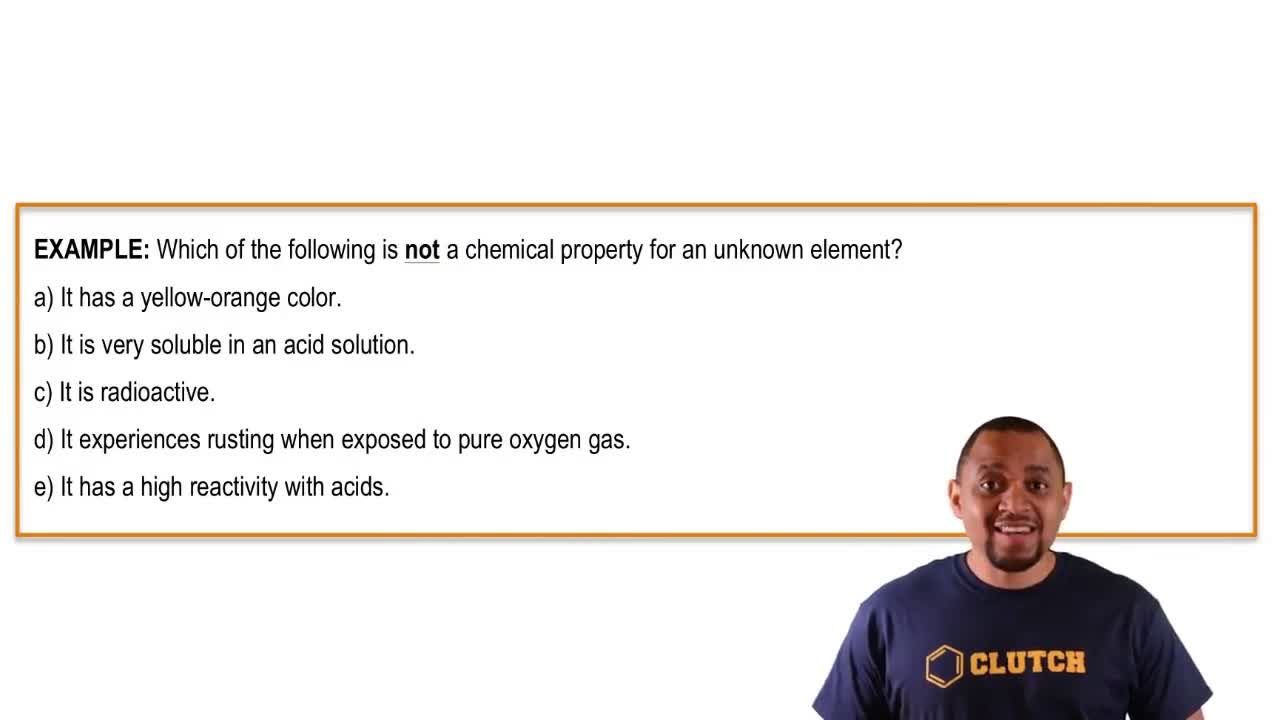
Chemical properties describe how a substance interacts with other substances during a chemical reaction. For example, sodium bromide (NaBr) is an ionic compound that does not burn, while ethane (C₂H₆) is a hydrocarbon that combusts. Recognizing these properties is crucial for predicting the behavior of substances in various chemical contexts.
Recommended video:
Guided course
02:11
Chemical Properties Example 1