Pearson+ LogoPearson+ Logo
Ch.11 Introduction to Organic Chemistry: Hydrocarbons
Timberlake - Chemistry: An Introduction to General, Organic, and Biological Chemistry 14th Edition
Timberlake14thChemistry: An Introduction to General, Organic, and Biological ChemistryISBN: 9781292472249Not the one you use?Change textbook
Chapter 11, Problem 3b

Identify each of the following properties as more typical of an organic or inorganic compound:
a. is soluble in water

Verified step by step guidance
1
Understand the distinction between organic and inorganic compounds: Organic compounds primarily contain carbon and hydrogen atoms and are often covalently bonded, while inorganic compounds typically do not contain carbon-hydrogen bonds and may include ionic bonds.
Recall the general solubility rule: Ionic compounds (common in inorganic chemistry) tend to dissolve in polar solvents like water due to the interaction between the ions and water molecules. Organic compounds, especially nonpolar ones, are less likely to dissolve in water unless they contain polar functional groups (e.g., -OH, -COOH).
Analyze the property in question: Solubility in water is a characteristic more typical of ionic compounds, which are often inorganic, because water is a polar solvent and can stabilize the ions.
Consider exceptions: Some organic compounds with polar functional groups can also dissolve in water, but this is less common compared to inorganic compounds.
Conclude that the property of being soluble in water is more typical of inorganic compounds, based on the general behavior of ionic substances in polar solvents like water.

Verified video answer for a similar problem:

This video solution was recommended by our tutors as helpful for the problem above.
Was this helpful?

Key Concepts

Here are the essential concepts you must grasp in order to answer the question correctly.

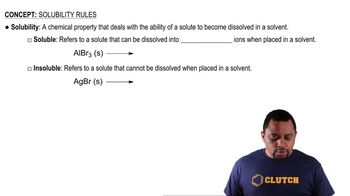
Solubility in Water

Solubility in water refers to the ability of a substance to dissolve in water, forming a homogeneous solution. This property is influenced by the molecular structure and polarity of the compound. Generally, polar compounds, which can form hydrogen bonds with water, tend to be more soluble in water compared to non-polar compounds.
Recommended video:
Guided course
02:07
Solubility Rules

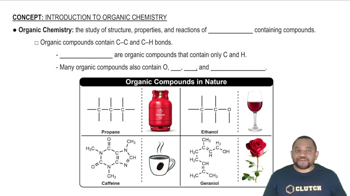
Organic Compounds

Organic compounds are primarily composed of carbon atoms, often in combination with hydrogen, oxygen, nitrogen, and other elements. They typically exhibit covalent bonding and can form complex structures, including chains and rings. Many organic compounds, such as alcohols and sugars, are soluble in water due to their polar functional groups.
Recommended video:
Guided course
2:26
Introduction to Organic Chemistry Concept 1

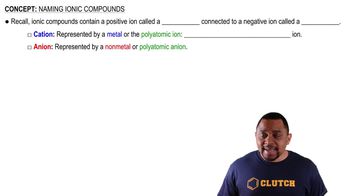
Inorganic Compounds

Inorganic compounds generally do not contain carbon-hydrogen bonds and include a wide range of substances, such as salts, minerals, and metals. Their solubility in water varies significantly; while some inorganic salts (like sodium chloride) are highly soluble, others (like many metal oxides) are not. Understanding the solubility of inorganic compounds often involves examining ionic interactions and lattice energy.
Recommended video:
Guided course
02:11
Naming Ionic Compounds