Pearson+ LogoPearson+ Logo
Ch.18 Metabolic Pathways and ATP Production
Timberlake - Chemistry: An Introduction to General, Organic, and Biological Chemistry 13th Edition
Timberlake13th EditionChemistry: An Introduction to General, Organic, and Biological ChemistryISBN: 9780134421353Not the one you use?Change textbook
Chapter 18, Problem 96c

Identify each of the following reactions a to e in the β oxidation of palmitic acid, a C16 fatty acid, as
(1) activation
(2) first oxidation
(3) hydration
(4) second oxidation
(5) cleavage
c. Palmitic acid, CoA, and ATP form palmitoyl CoA.

Verified step by step guidance
1
Step 1: Understand the context of the problem. The β-oxidation of fatty acids is a metabolic process where fatty acids are broken down to generate acetyl-CoA, NADH, and FADH₂. The process involves several steps: activation, first oxidation, hydration, second oxidation, and cleavage.
Step 2: Analyze the given reaction. The problem states that palmitic acid, CoA (coenzyme A), and ATP form palmitoyl CoA. This indicates the initial step of preparing the fatty acid for β-oxidation.
Step 3: Recall the activation step. In the activation step, a fatty acid reacts with ATP and CoA to form an acyl-CoA (in this case, palmitoyl CoA). This step is catalyzed by the enzyme acyl-CoA synthetase and requires energy input from ATP.
Step 4: Match the reaction to the correct step in β-oxidation. Since the reaction involves the formation of palmitoyl CoA from palmitic acid, CoA, and ATP, it corresponds to the activation step of β-oxidation.
Step 5: Conclude that the reaction described (palmitic acid, CoA, and ATP forming palmitoyl CoA) is classified as the activation step in the β-oxidation of palmitic acid.

Verified video answer for a similar problem:

This video solution was recommended by our tutors as helpful for the problem above.
Video duration:
1m
Was this helpful?

Key Concepts

Here are the essential concepts you must grasp in order to answer the question correctly.

β-Oxidation

β-Oxidation is a metabolic process that breaks down fatty acids into acetyl-CoA units, which can then enter the citric acid cycle for energy production. This process occurs in the mitochondria and involves a series of enzymatic reactions that sequentially remove two-carbon units from the fatty acid chain.

Activation of Fatty Acids

The activation of fatty acids is the first step in β-oxidation, where fatty acids are converted into acyl-CoA derivatives. This reaction is catalyzed by the enzyme acyl-CoA synthetase and requires ATP, which is hydrolyzed to AMP and pyrophosphate, making the fatty acid ready for subsequent oxidation.
Recommended video:
Guided course
2:00
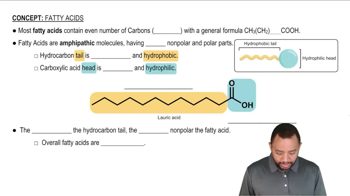
Fatty Acids Concept 1

Enzymatic Reactions in β-Oxidation

The β-oxidation pathway consists of four main enzymatic reactions: oxidation, hydration, a second oxidation, and cleavage. Each of these steps is crucial for the systematic breakdown of fatty acids, with specific enzymes facilitating the conversion of acyl-CoA to acetyl-CoA, ultimately releasing energy stored in the fatty acid.
Recommended video:
Guided course
1:32
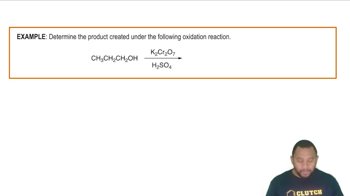
Alcohol Reactions Oxidation Reactions Example 1