Pearson+ LogoPearson+ Logo
Ch.17 Nucleic Acids and Protein Synthesis
Timberlake - Chemistry: An Introduction to General, Organic, and Biological Chemistry 13th Edition
Timberlake13th EditionChemistry: An Introduction to General, Organic, and Biological ChemistryISBN: 9780134421353Not the one you use?Change textbook
Chapter 17, Problem 122(5)

Match each of the following processes (1 to 5) with one of the items (a to e):
5. reverse transcription
a. amino acids are linked together
b. RNA template is used to synthesize DNA
c. helicase unwinds DNA
d. genetic information is transferred from DNA
e. sticky ends join new DNA segment

Verified step by step guidance
1
Step 1: Understand the process of reverse transcription. Reverse transcription is the process where an RNA template is used to synthesize DNA. This is the reverse of the usual transcription process, where DNA is used to synthesize RNA.
Step 2: Match the description of reverse transcription with the provided options. Look for the option that describes the synthesis of DNA from an RNA template.
Step 3: Identify the correct match. The option that states 'RNA template is used to synthesize DNA' corresponds to the process of reverse transcription.
Step 4: Verify the match by ensuring that none of the other options (a, c, d, e) describe the process of reverse transcription. For example, 'amino acids are linked together' refers to protein synthesis, not reverse transcription.
Step 5: Conclude that the correct match for reverse transcription is option 'b: RNA template is used to synthesize DNA'.

Verified video answer for a similar problem:

This video solution was recommended by our tutors as helpful for the problem above.
Video duration:
2m
Was this helpful?

Key Concepts

Here are the essential concepts you must grasp in order to answer the question correctly.

Reverse Transcription

Reverse transcription is the process by which RNA is used as a template to synthesize complementary DNA (cDNA). This process is catalyzed by the enzyme reverse transcriptase and is crucial in retroviruses, allowing them to integrate their genetic material into the host's DNA.
Recommended video:
Guided course
6:37
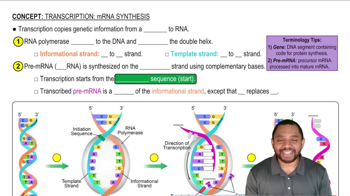
Transcription: mRNA Synthesis Concept 1

Transcription

Transcription is the process of copying a segment of DNA into RNA. During this process, the enzyme RNA polymerase binds to the DNA and synthesizes a single-stranded RNA molecule, which serves as a template for protein synthesis in the next step, translation.
Recommended video:
Guided course
6:37
Transcription: mRNA Synthesis Concept 1

DNA Replication

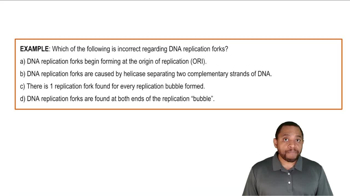
DNA replication is the biological process of producing two identical replicas of DNA from one original DNA molecule. This process involves several key enzymes, including helicase, which unwinds the DNA double helix, allowing for the synthesis of new complementary strands.
Recommended video:
Guided course
1:40
Intro to DNA Replication Example 2