Pearson+ LogoPearson+ Logo
Ch.4 Introduction to Organic Compounds
Frost - General, Organic and Biological Chemistry 4th Edition
Frost4th EditionGeneral, Organic and Biological ChemistryISBN: 9780134988696Not the one you use?Change textbook
Chapter 1, Problem 50a

Give the structure and name of the cycloalkanes described.
(a) A compound whose molecular formula is C7H14 and contains a six-membered ring

Verified step by step guidance
1
Step 1: Understand the molecular formula C₇H₁₄. This formula indicates that the compound is a cycloalkane because it follows the general formula for cycloalkanes, CₙH₂ₙ, where n is the number of carbon atoms.
Step 2: Recognize that the problem specifies a six-membered ring. This means the cycloalkane has six carbon atoms forming a ring structure, with one additional carbon atom attached as a substituent.
Step 3: Draw the base structure of cyclohexane, which is a six-membered ring of carbon atoms, each bonded to two hydrogen atoms.
Step 4: Add the seventh carbon atom as a substituent to one of the carbon atoms in the cyclohexane ring. This creates a methyl group (-CH₃) attached to the ring.
Step 5: Name the compound according to IUPAC nomenclature. The base name is 'methylcyclohexane,' where 'methyl' indicates the substituent and 'cyclohexane' refers to the six-membered ring structure.

Verified video answer for a similar problem:

This video solution was recommended by our tutors as helpful for the problem above.
Video duration:
4m
Was this helpful?

Key Concepts

Here are the essential concepts you must grasp in order to answer the question correctly.

Cycloalkanes

Cycloalkanes are a class of hydrocarbons that contain carbon atoms arranged in a ring structure. They are saturated compounds, meaning they have single bonds between carbon atoms and follow the general formula CnH2n, where n is the number of carbon atoms. Cycloalkanes can vary in size and complexity, with common examples including cyclopropane, cyclobutane, and cyclohexane.
Recommended video:
Guided course
0:36
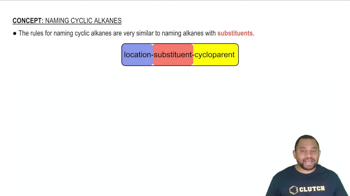
Rules for Naming Cyclic Alkanes Concept 1

Molecular Formula

A molecular formula represents the number and types of atoms in a molecule, providing essential information about its composition. For example, the molecular formula C₇H₁₄ indicates that the compound contains seven carbon atoms and fourteen hydrogen atoms. This formula helps in identifying the structure and classification of the compound, particularly in organic chemistry.
Recommended video:
Guided course
02:08
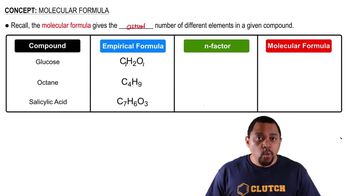
Molecular Formula

Structural Isomerism

Structural isomerism occurs when compounds have the same molecular formula but differ in the arrangement of atoms. In the case of C₇H₁₄, there can be multiple cycloalkane structures, such as cyclohexane with a methyl group (1-methylcyclohexane) or other variations. Understanding structural isomerism is crucial for identifying the specific compound and its properties.
Recommended video:
Guided course
1:01
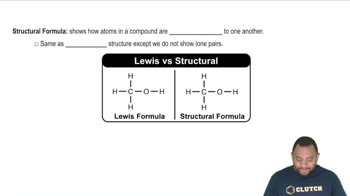
Structural Formula Concept 2