Pearson+ LogoPearson+ Logo
Ch. 9 - The Molecular Biology of Translation
Sanders - Genetic Analysis: An Integrated Approach 3rd Edition
Sanders3rd EditionGenetic Analysis: An Integrated ApproachISBN: 9780135564172Not the one you use?Change textbook
Chapter 9, Problem 12b

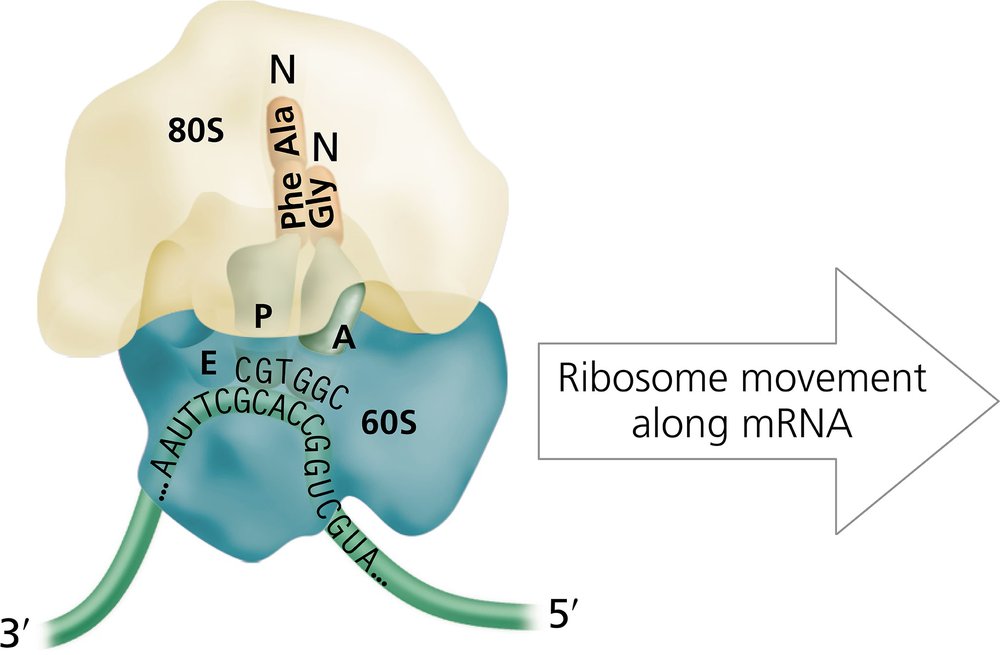
The diagram of a eukaryotic ribosome shown below contains several errors.
Diagram of a eukaryotic ribosome with labeled sites and mRNA sequence, indicating errors to be corrected.
Redraw the diagram, and correct each error using the mRNA sequence shown.

Verified step by step guidance
1
Identify the errors in the provided eukaryotic ribosome diagram. Common errors might include incorrect labeling of ribosomal subunits, misplacement of mRNA, tRNA, or codons, or incorrect orientation of the ribosome components.
Review the mRNA sequence provided in the problem. Ensure that the sequence is correctly oriented (5' to 3') and matches the direction of translation in a eukaryotic ribosome.
Redraw the ribosome diagram, ensuring that the large (60S) and small (40S) subunits are correctly labeled and positioned. The mRNA should pass through the small subunit, with the start codon (AUG) positioned in the P site.
Correctly position the tRNA molecules in the ribosome. The tRNA carrying methionine (initiator tRNA) should be in the P site, and the next tRNA should align with the codon in the A site.
Ensure that the ribosome diagram reflects the correct translation process, including the direction of movement (5' to 3') and the proper alignment of codons, anticodons, and amino acids being added to the growing polypeptide chain.

Verified video answer for a similar problem:

This video solution was recommended by our tutors as helpful for the problem above.
Video duration:
3m
Was this helpful?

Key Concepts

Here are the essential concepts you must grasp in order to answer the question correctly.

Eukaryotic Ribosome Structure

Eukaryotic ribosomes are complex molecular machines composed of ribosomal RNA (rRNA) and proteins. They consist of two subunits: the large subunit (60S) and the small subunit (40S). These subunits come together during protein synthesis to translate mRNA into polypeptides, ensuring accurate reading of the genetic code.
Recommended video:
Guided course
03:49
Ribosome Structure

mRNA Sequence and Codons

Messenger RNA (mRNA) is a single-stranded molecule that carries genetic information from DNA to the ribosome for protein synthesis. The mRNA sequence is read in sets of three nucleotides called codons, each of which corresponds to a specific amino acid. Understanding the codon sequence is crucial for accurately translating the mRNA into a functional protein.
Recommended video:
Guided course
08:41
Sequencing Difficulties

Translation Process

Translation is the process by which ribosomes synthesize proteins using the information encoded in mRNA. It involves three main stages: initiation, elongation, and termination. During this process, tRNA molecules bring amino acids to the ribosome, matching their anticodons with the mRNA codons, ultimately forming a polypeptide chain that folds into a functional protein.
Recommended video:
Guided course
08:39
mRNA Processing
Related Practice
Textbook Question

If you were to look up Gaucher disease on the OMIM website, you would see that there are three major types, designated Type I (OMIM 230800), Type II (OMIM 230900), and Type III (OMIM 231000). All three types are mutations of the gene for acid-β-glucosidase, encoded on chromosome 1. Different mutations of this gene produce the three types of Gaucher disease that differ somewhat in their symptoms and disease severity.

Thinking about the production or function of the acid-β-glucosidase enzyme, why do you suppose different mutations of this gene produce differences in symptoms and disease severity?

Textbook Question

If you were to look up Gaucher disease on the OMIM website, you would see that there are three major types, designated Type I (OMIM 230800), Type II (OMIM 230900), and Type III (OMIM 231000). All three types are mutations of the gene for acid-β-glucosidase, encoded on chromosome 1. Different mutations of this gene produce the three types of Gaucher disease that differ somewhat in their symptoms and disease severity.

For each mutation, speculate about whether the acid-β-glucosidase enzyme is merely reduced in function or whether its production is eliminated, and explain why.

Textbook Question

The diagram of a eukaryotic ribosome shown below contains several errors.

Examine the diagram carefully, and identify each error.

Textbook Question

Third-base wobble allows some tRNAs to recognize more than one mRNA codon. Based on this chapter's discussion of wobble, what is the minimal number of tRNA molecules necessary to recognize the following amino acids?

Leucine

Textbook Question

Third-base wobble allows some tRNAs to recognize more than one mRNA codon. Based on this chapter's discussion of wobble, what is the minimal number of tRNA molecules necessary to recognize the following amino acids?

Arginine

Textbook Question

Third-base wobble allows some tRNAs to recognize more than one mRNA codon. Based on this chapter's discussion of wobble, what is the minimal number of tRNA molecules necessary to recognize the following amino acids?

Isoleucine