Pearson+ LogoPearson+ Logo
Ch. 7 - DNA Structure and Replication
Sanders - Genetic Analysis: An Integrated Approach 3rd Edition
Sanders3rd EditionGenetic Analysis: An Integrated ApproachISBN: 9780135564172Not the one you use?Change textbook
Chapter 7, Problem 12

Explain how RNA participates in DNA replication.

Verified step by step guidance
1
RNA plays a role in DNA replication by providing a starting point for DNA synthesis. This is achieved through the synthesis of short RNA primers by the enzyme primase.
Primase synthesizes RNA primers complementary to the DNA template strand. These primers are typically 10-12 nucleotides long and are necessary because DNA polymerase cannot initiate synthesis on its own; it requires a free 3' hydroxyl group to add nucleotides.
Once the RNA primer is in place, DNA polymerase begins synthesizing the new DNA strand by adding deoxyribonucleotides to the 3' end of the primer, extending the strand in the 5' to 3' direction.
As replication progresses, the RNA primers are eventually removed by enzymes such as RNase H or DNA polymerase I, which degrade the RNA and replace it with DNA nucleotides.
Finally, DNA ligase seals the gaps between the newly synthesized DNA fragments (Okazaki fragments on the lagging strand), ensuring the continuity of the DNA molecule.

Verified video answer for a similar problem:

This video solution was recommended by our tutors as helpful for the problem above.
Video duration:
1m
Was this helpful?

Key Concepts

Here are the essential concepts you must grasp in order to answer the question correctly.

Role of RNA Primase

RNA primase is an enzyme that synthesizes short RNA primers during DNA replication. These primers provide a starting point for DNA polymerase, which cannot initiate synthesis without a primer. The RNA primers are complementary to the DNA template and are later replaced by DNA nucleotides.
Recommended video:

Transcription vs. Replication

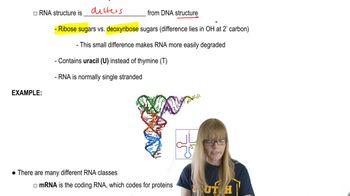
While DNA replication involves copying the entire DNA molecule, transcription is the process of synthesizing RNA from a DNA template. Understanding this distinction is crucial, as RNA's role in replication is primarily as a primer, whereas in transcription, RNA serves as a messenger carrying genetic information from DNA to ribosomes for protein synthesis.
Recommended video:
Guided course
14:31
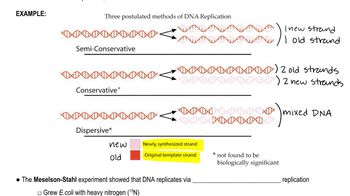
Semiconservative Replication

Okazaki Fragments

During DNA replication, the lagging strand is synthesized discontinuously in short segments known as Okazaki fragments. Each fragment begins with an RNA primer laid down by RNA primase. These fragments are later joined together by DNA ligase, highlighting the essential role of RNA in facilitating the replication of the lagging strand.
Recommended video:
Guided course
11:59
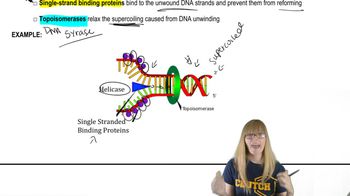
Steps to DNA Replication