Pearson+ LogoPearson+ Logo
Ch. 6 - Genetic Analysis and Mapping in Bacteria and Bacteriophages
Sanders - Genetic Analysis: An Integrated Approach 3rd Edition
Sanders3rd EditionGenetic Analysis: An Integrated ApproachISBN: 9780135564172Not the one you use?Change textbook
Chapter 6, Problem 4

Bacteria transfer genes by conjugation, transduction, and transformation. Compare and contrast these mechanisms. In your answer, identify which if any processes involve homologous recombination and which if any do not.

Verified step by step guidance
1
Identify the three mechanisms of gene transfer in bacteria: conjugation, transduction, and transformation.
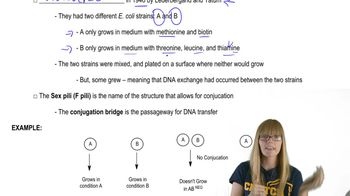
Explain conjugation: a process where genetic material is transferred between bacterial cells through direct contact, often involving a pilus. Note that homologous recombination can occur if the transferred DNA is integrated into the recipient's genome.
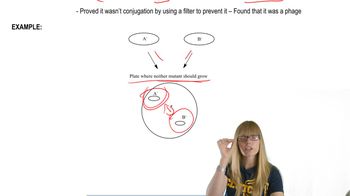
Describe transduction: a process where bacterial DNA is transferred from one bacterium to another by a virus (bacteriophage). Homologous recombination may occur if the DNA is integrated into the recipient's genome.
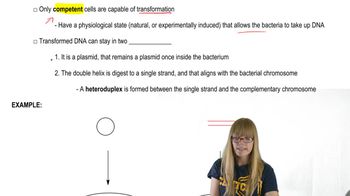
Discuss transformation: a process where bacteria take up free DNA from their environment. Homologous recombination is involved if the DNA is integrated into the bacterial chromosome.
Compare and contrast: Highlight that all three processes can involve homologous recombination if the transferred DNA is integrated into the recipient's genome, but the initial mechanisms of transfer differ (direct contact in conjugation, viral mediation in transduction, and environmental uptake in transformation).

Verified video answer for a similar problem:

This video solution was recommended by our tutors as helpful for the problem above.
Video duration:
2m
Was this helpful?

Key Concepts

Here are the essential concepts you must grasp in order to answer the question correctly.

Conjugation

Conjugation is a process where bacteria transfer genetic material through direct contact, typically via a pilus. This mechanism allows for the transfer of plasmids, which can carry antibiotic resistance genes. Conjugation does not inherently involve homologous recombination, as the transferred DNA can exist as an independent plasmid.
Recommended video:
Guided course
04:06
Conjugation Overview

Transduction

Transduction is the transfer of genetic material between bacteria via bacteriophages (viruses that infect bacteria). During this process, a bacteriophage can accidentally incorporate bacterial DNA and transfer it to another bacterium. This mechanism can involve homologous recombination if the transferred DNA integrates into the recipient's genome.
Recommended video:

Transformation

Transformation is the uptake of free DNA from the environment by a bacterial cell. This process can occur naturally or be induced artificially in laboratory settings. Transformation can lead to homologous recombination if the incorporated DNA shares sequence similarity with the recipient's genome, allowing for genetic integration.
Recommended video:
Guided course
05:48
Transformation
Related Practice
Textbook Question

Go online to the Online Mendelian Inheritance of Man (OMIM) website. Look up the following genetic conditions and answer the questions posed about them.

Look up cystic fibrosis (CF), OMIM 602421, and give the gene name and abbreviation and the chromosome location of the gene.

Textbook Question

Conjugation between an Hfr cell and an F⁻ cell does not usually result in conversion of exconjugants to the donor state. Occasionally, however, the result of this conjugation is two Hfr cells. Explain how this occurs.

Textbook Question

A couple comes into your genetic counseling practice with a question about the chance a future child of theirs might have a genetic disease. Three or four men in the woman's family, including her father, had a condition that might be genetic. Although her father is still alive, she has had little contact with him for much of her life and cannot describe or name the condition. Her partner is a healthy man whose family has no history indicating the presence of a genetic condition. To provide more information about this possible genetic condition for the couple, what is the first step you recommend?

4
views
Textbook Question

Explain the importance of the following features in conjugating donor bacteria:

the origin of transfer

Textbook Question

Explain the importance of the following features in conjugating donor bacteria:

the conjugation pilus

Textbook Question

Explain the importance of the following features in conjugating donor bacteria:

homologous recombination

4
views