Pearson+ LogoPearson+ Logo
Ch. 3 - Cell Division and Chromosome Heredity
Sanders - Genetic Analysis: An Integrated Approach 3rd Edition
Sanders3rd EditionGenetic Analysis: An Integrated ApproachISBN: 9780135564172Not the one you use?Change textbook
Chapter 3, Problem 19a

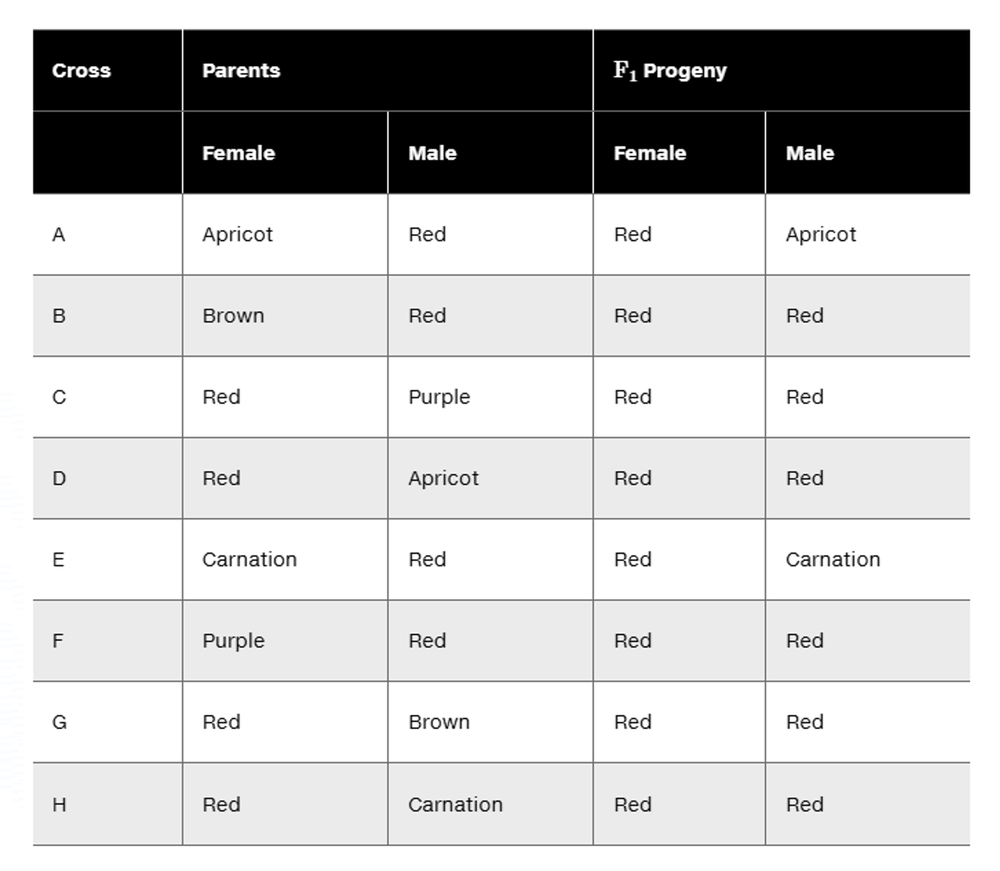
Four eye-color mutants in Drosophila—apricot, brown, carnation, and purple—are inherited as recessive traits. Red is the dominant wild-type color of fruit-fly eyes. Eight crosses (A through H) are made between parents from pure-breeding lines.
Table showing crosses of Drosophila eye-color mutants and their F1 progeny results.
Which of these eye-color mutants are X-linked recessive and which are autosomal recessive? Explain how you distinguish X-linked from autosomal heredity.

Verified step by step guidance
1
Understand the problem: The goal is to determine which of the four eye-color mutants (apricot, brown, carnation, and purple) are X-linked recessive and which are autosomal recessive. X-linked traits are carried on the X chromosome, while autosomal traits are carried on non-sex chromosomes. The inheritance patterns in the crosses will help us distinguish between these two types of inheritance.
Step 1: Analyze the inheritance patterns in the eight crosses (A through H). Specifically, look for differences in the phenotypes of male and female offspring. X-linked recessive traits often show distinct patterns, such as males being more frequently affected because they have only one X chromosome.
Step 2: For each cross, determine whether the trait is passed from mothers to sons or fathers to daughters. X-linked traits cannot be passed from father to son, as sons inherit their X chromosome from their mother. If a trait is passed from father to son, it is autosomal.
Step 3: Examine whether heterozygous females (carriers) show the recessive phenotype. In X-linked recessive traits, heterozygous females typically do not express the trait, while males with the recessive allele do. For autosomal recessive traits, both males and females must inherit two recessive alleles to express the trait.
Step 4: Summarize the findings for each mutant (apricot, brown, carnation, and purple) based on the inheritance patterns observed in the crosses. Classify each mutant as either X-linked recessive or autosomal recessive, providing reasoning based on the patterns of inheritance described in the previous steps.

Verified video answer for a similar problem:

This video solution was recommended by our tutors as helpful for the problem above.
Video duration:
3m
Was this helpful?

Key Concepts

Here are the essential concepts you must grasp in order to answer the question correctly.

X-linked Inheritance

X-linked inheritance refers to genes located on the X chromosome. In this mode of inheritance, males (XY) are more likely to express recessive traits because they have only one X chromosome. If a male inherits a recessive allele on his X chromosome, he will exhibit the trait, while females (XX) require two copies of the recessive allele to express the trait. This is crucial for identifying which eye-color mutants are X-linked.
Recommended video:
Guided course
09:30
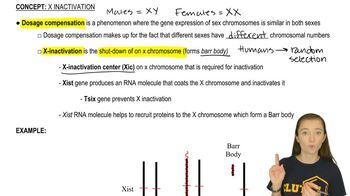
X-Inactivation

Autosomal Inheritance

Autosomal inheritance involves genes located on the non-sex chromosomes (autosomes). Traits inherited in this manner can be expressed in both males and females equally, as both sexes have two copies of each autosome. Recessive traits will only manifest if an individual inherits two copies of the recessive allele. Understanding this concept helps differentiate between traits that are autosomal recessive and those that are X-linked.
Recommended video:
Guided course
09:08
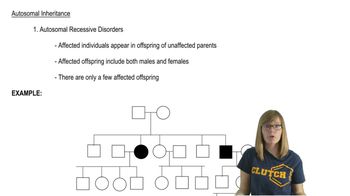
Autosomal Pedigrees

Distinguishing X-linked from Autosomal Traits

To distinguish X-linked traits from autosomal traits, one can analyze the inheritance patterns in offspring. If a trait predominantly affects males and is passed from carrier mothers to affected sons, it is likely X-linked. Conversely, if both sexes are equally affected and the trait can skip generations, it is likely autosomal recessive. This analysis is essential for determining the inheritance patterns of the eye-color mutants in Drosophila.
Recommended video:
Guided course
09:30
X-Inactivation
Related Practice
Textbook Question

In cats, tortoiseshell coat color appears in females. A tortoiseshell coat has patches of dark brown fur and patches of orange fur that each in total cover about half the body but have a unique pattern in each female. Male cats can be either dark brown or orange, but a male cat with tortoiseshell coat is rarely produced. Two sample crosses between males and females from pure-breeding lines produced the tortoiseshell females shown.


Cross I     P: dark brown male × orange female

           F₁: orange males and tortoiseshell females

Cross II    P: orange male × dark brown female

           F₁: dark brown males and tortoiseshell females


Why are tortoiseshell cats female?

Textbook Question

In cats, tortoiseshell coat color appears in females. A tortoiseshell coat has patches of dark brown fur and patches of orange fur that each in total cover about half the body but have a unique pattern in each female. Male cats can be either dark brown or orange, but a male cat with tortoiseshell coat is rarely produced. Two sample crosses between males and females from pure-breeding lines produced the tortoiseshell females shown.


Cross I     P: dark brown male × orange female

           F₁: orange males and tortoiseshell females

Cross II    P: orange male × dark brown female

           F₁: dark brown males and tortoiseshell females


The genetics service of a large veterinary hospital gets referrals for three or four male tortoiseshell cats every year. These cats are invariably sterile and have underdeveloped testes. How are these tortoiseshell male cats produced? Why do you think they are sterile?

Textbook Question

The gene causing Coffin–Lowry syndrome (OMIM 303600) was recently identified and mapped on the human X chromosome. Coffin–Lowry syndrome is a rare disorder affecting brain morphology and development. It also produces skeletal and growth abnormalities, as well as abnormalities of motor control. Coffin–Lowry syndrome affects males who inherit a mutation of the X-linked gene. Most carrier females show no symptoms of the disease but a few carriers do. These carrier females are always less severely affected than males. Offer an explanation for this finding.

Textbook Question

Four eye-color mutants in Drosophila—apricot, brown, carnation, and purple—are inherited as recessive traits. Red is the dominant wild-type color of fruit-fly eyes. Eight crosses (A through H) are made between parents from pure-breeding lines.

Predict F2 phenotype ratios of crosses A, B, D, and G.

Textbook Question

For each pedigree shown,

Identify which simple pattern of hereditary transmission (autosomal dominant, autosomal recessive, X-linked dominant, or X-linked recessive) is most likely to have occurred. Give genotypes for individuals involved in transmitting the trait. 

Textbook Question

For each pedigree shown,

Determine which other pattern(s) of transmission is/are possible. For each possible mode of transmission, specify the genotypes necessary for transmission to occur.

5
views