Pearson+ LogoPearson+ Logo
Ch. 3 - Cell Division and Chromosome Heredity
Sanders - Genetic Analysis: An Integrated Approach 3rd Edition
Sanders3rd EditionGenetic Analysis: An Integrated ApproachISBN: 9780135564172Not the one you use?Change textbook
Chapter 3, Problem 20c

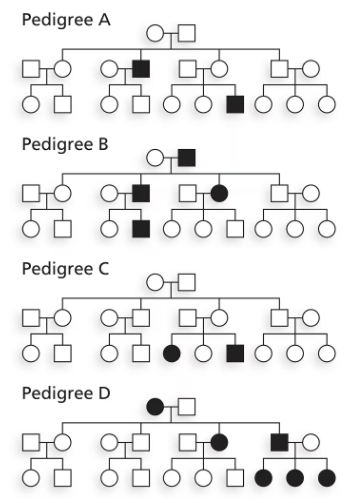
For each pedigree shown,
Four pedigrees illustrating inheritance patterns, with symbols indicating affected and unaffected individuals.
Identify which pattern(s) of transmission is/are impossible. Specify why transmission is impossible.

Verified step by step guidance
1
Examine the pedigree carefully to identify the inheritance pattern. Look for key features such as whether the trait is dominant or recessive, autosomal or sex-linked, and whether it skips generations.
Determine if the trait is autosomal or sex-linked by analyzing whether males and females are equally affected. If males are predominantly affected, it may suggest X-linked inheritance.
Check for evidence of dominant or recessive inheritance. If the trait appears in every generation, it is likely dominant. If it skips generations, it is likely recessive.
Evaluate the transmission of the trait from parents to offspring. For example, if an affected father passes the trait to all daughters but no sons, it suggests X-linked dominant inheritance. If an affected mother passes the trait to all offspring, it suggests mitochondrial inheritance.
Identify patterns that are impossible based on the observed data. For example, if an affected father passes the trait to a son in an X-linked recessive pattern, this is impossible because males inherit their X chromosome from their mother.

Verified video answer for a similar problem:

This video solution was recommended by our tutors as helpful for the problem above.
Video duration:
1m
Was this helpful?

Key Concepts

Here are the essential concepts you must grasp in order to answer the question correctly.

Pedigree Analysis

Pedigree analysis is a diagrammatic method used to trace the inheritance of traits through generations in a family. It helps identify patterns of inheritance, such as autosomal dominant, autosomal recessive, X-linked dominant, and X-linked recessive traits. Understanding how traits are passed down allows for the identification of impossible transmission patterns based on the observed inheritance in the pedigree.
Recommended video:
Guided course
01:59
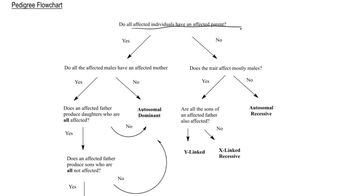
Pedigree Flowchart

Modes of Inheritance

Modes of inheritance refer to the ways in which genetic traits are transmitted from parents to offspring. Key modes include autosomal dominant, where only one copy of a mutated gene is needed for the trait to manifest, and autosomal recessive, where two copies are required. Recognizing these patterns is crucial for determining which traits can or cannot be passed on in a pedigree.
Recommended video:
Guided course
05:13
Organelle Inheritance

Genetic Consanguinity

Genetic consanguinity refers to the genetic relationship between individuals who share a common ancestor. In pedigrees, consanguinity can increase the likelihood of recessive traits appearing, as relatives may carry the same alleles. Understanding the implications of consanguinity is essential for assessing the probability of certain traits being inherited and identifying impossible transmission scenarios.
Recommended video:
Guided course
03:45
Descriptive Genetics
Related Practice
Textbook Question

Four eye-color mutants in Drosophila—apricot, brown, carnation, and purple—are inherited as recessive traits. Red is the dominant wild-type color of fruit-fly eyes. Eight crosses (A through H) are made between parents from pure-breeding lines.

Predict F2 phenotype ratios of crosses A, B, D, and G.

Textbook Question

For each pedigree shown,

Identify which simple pattern of hereditary transmission (autosomal dominant, autosomal recessive, X-linked dominant, or X-linked recessive) is most likely to have occurred. Give genotypes for individuals involved in transmitting the trait. 

Textbook Question

For each pedigree shown,

Determine which other pattern(s) of transmission is/are possible. For each possible mode of transmission, specify the genotypes necessary for transmission to occur.

5
views
Textbook Question

Use the blank pedigrees provided to depict transmission of

(a) an X-linked recessive trait and

(b) an X-linked dominant trait, by filling in circles and squares to represent individuals with the trait of interest. Give genotypes for each person in each pedigree.

Carefully design each transmission pattern so that pedigree

(a) cannot be confused with autosomal recessive transmission and pedigree

(b) cannot be confused with autosomal dominant transmission. Identify the transmission events that eliminate the possibility of autosomal transmission for each pedigree.

5
views
Textbook Question

The following figure illustrates reciprocal crosses involving chickens with sex-linked dominant barred mutation. For Cross A and for Cross B, cross the F₁ roosters and hens and predict the feather patterns of roosters and hens in the F2.

3
views
Textbook Question

In fruit flies, yellow body (y) is recessive to gray body , and the trait of body color is inherited on the X chromosome. Vestigial wing (v) is recessive to full-sized wing (v⁺), and the trait has autosomal inheritance. A cross of a male with yellow body and full wings to a female with gray body and full wings is made. Based on an analysis of the progeny of the cross shown below, determine the genotypes of parental and progeny flies.

[Table below appears at this point containing crosses and results]