Pearson+ LogoPearson+ Logo
Ch. 3 - Cell Division and Chromosome Heredity
Sanders - Genetic Analysis: An Integrated Approach 3rd Edition
Sanders3rd EditionGenetic Analysis: An Integrated ApproachISBN: 9780135564172Not the one you use?Change textbook
Chapter 3, Problem 12d

A woman's father has ornithine transcarbamylase deficiency (OTD), an X-linked recessive disorder producing mental deterioration if not properly treated. The woman's mother is homozygous for the wild-type allele.


Identify a male with whom the woman could produce a daughter with OTD.

Verified step by step guidance
1
Understand the inheritance pattern: Ornithine transcarbamylase deficiency (OTD) is an X-linked recessive disorder. This means the gene responsible for the disorder is located on the X chromosome, and males (XY) are more likely to express the disorder because they have only one X chromosome.
Analyze the woman's genotype: Since the woman's father has OTD, he must have passed his affected X chromosome to her. Her mother is homozygous for the wild-type allele, so the woman is heterozygous (X^OT/X^+), where X^OT represents the affected allele and X^+ represents the wild-type allele.
Determine the genotype of a male partner: To produce a daughter with OTD, the daughter must inherit the affected X chromosome (X^OT) from her mother and another affected X chromosome (X^OT) from her father. This means the male partner must have OTD and carry the affected X chromosome (X^OT).
Explain the male partner's genotype: Since males are XY, a male with OTD would have the genotype X^OT/Y. This ensures that he can pass the affected X chromosome (X^OT) to his daughters.
Conclude the pairing: The woman (X^OT/X^+) must have children with a male who has OTD (X^OT/Y) to produce a daughter with the genotype X^OT/X^OT, which would result in the daughter having OTD.

Verified video answer for a similar problem:

This video solution was recommended by our tutors as helpful for the problem above.
Video duration:
2m
Was this helpful?

Key Concepts

Here are the essential concepts you must grasp in order to answer the question correctly.

X-Linked Recessive Inheritance

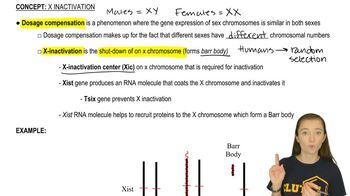
X-linked recessive inheritance refers to genetic conditions that are associated with genes located on the X chromosome. Males, having one X and one Y chromosome, are more likely to express these disorders because they have only one copy of the X chromosome. In contrast, females have two X chromosomes, so they can be carriers without showing symptoms if they have one normal allele.
Recommended video:
Guided course
09:30
X-Inactivation

Genotype of the Woman

The woman in the scenario has a father with ornithine transcarbamylase deficiency, meaning he has the affected genotype (X^dY). Since her mother is homozygous for the wild-type allele (X^WX^W), the woman must be a carrier (X^dX^W), possessing one affected X chromosome from her father and one normal X chromosome from her mother.
Recommended video:
Guided course
07:52
Gamete Genotypes

Possible Male Genotype

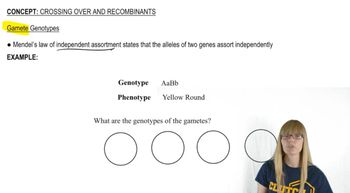
To produce a daughter with ornithine transcarbamylase deficiency, the male partner must provide an X chromosome carrying the affected allele (X^d). Since males have one X and one Y chromosome, a male with the genotype X^dY would be necessary. This male would pass on the X^d chromosome to any daughters, resulting in a 50% chance of them inheriting the disorder if the woman is a carrier.
Recommended video:
Guided course
07:52
Gamete Genotypes
Related Practice
Textbook Question

A woman's father has ornithine transcarbamylase deficiency (OTD), an X-linked recessive disorder producing mental deterioration if not properly treated. The woman's mother is homozygous for the wild-type allele.


What is the woman's genotype? (Use D to represent the dominant allele and d to represent the recessive allele.)

Textbook Question

A woman's father has ornithine transcarbamylase deficiency (OTD), an X-linked recessive disorder producing mental deterioration if not properly treated. The woman's mother is homozygous for the wild-type allele.


If the woman has a son with a man who does not have OTD, what is the chance the son will have OTD?

Textbook Question

A woman's father has ornithine transcarbamylase deficiency (OTD), an X-linked recessive disorder producing mental deterioration if not properly treated. The woman's mother is homozygous for the wild-type allele.


If the woman has a daughter with a man who does not have OTD, what is the chance the daughter will be a heterozygous carrier of OTD? What is the chance the daughter will have OTD?

Textbook Question

A woman's father has ornithine transcarbamylase deficiency (OTD), an X-linked recessive disorder producing mental deterioration if not properly treated. The woman's mother is homozygous for the wild-type allele.


What proportion of daughters produced by the woman and the man are expected to have OTD? What proportion of sons of the woman and the man are expected to have OTD?

Textbook Question

In humans, hemophilia A (OMIM 306700) is an X-linked recessive disorder that affects the gene for factor VIII protein, which is essential for blood clotting. The dominant and recessive alleles for the factor VIII gene are represented by H and h. Albinism is an autosomal recessive condition that results from mutation of the gene producing tyrosinase, an enzyme in the melanin synthesis pathway. A and a represent the tyrosinase alleles. A healthy woman named Clara (II-2), whose father (I-1) has hemophilia and whose brother (II-1) has albinism, is married to a healthy man named Charles (II-3), whose parents are healthy. Charles's brother (II-5) has hemophilia, and his sister (II-4) has albinism. The pedigree is shown below.

What are the genotypes of the four parents (I-1 to I-4) in this pedigree?

Textbook Question

In humans, hemophilia A (OMIM 306700) is an X-linked recessive disorder that affects the gene for factor VIII protein, which is essential for blood clotting. The dominant and recessive alleles for the factor VIII gene are represented by H and h. Albinism is an autosomal recessive condition that results from mutation of the gene producing tyrosinase, an enzyme in the melanin synthesis pathway. A and a represent the tyrosinase alleles. A healthy woman named Clara (II-2), whose father (I-1) has hemophilia and whose brother (II-1) has albinism, is married to a healthy man named Charles (II-3), whose parents are healthy. Charles's brother (II-5) has hemophilia, and his sister (II-4) has albinism. The pedigree is shown below.

Determine the probability that the first child of Clara and Charles will be a


i. boy with hemophilia

ii. girl with albinism

iii. healthy girl

iv. boy with both albinism and hemophilia

v. boy with albinism

vi. girl with hemophilia