Pearson+ LogoPearson+ Logo
Ch. 20 - Population Genetics and Evolution at the Population, Species, and Molecular Levels
Sanders - Genetic Analysis: An Integrated Approach 3rd Edition
Sanders3rd EditionGenetic Analysis: An Integrated ApproachISBN: 9780135564172Not the one you use?Change textbook
Chapter 20, Problem 1a

Compare and contrast the terms in each of the following pairs:
Population and gene pool

Verified step by step guidance
1
Define 'population': A population in genetics refers to a group of individuals of the same species that live in a specific geographic area and are capable of interbreeding. This group shares a common set of genes and alleles.
Define 'gene pool': A gene pool encompasses all the genetic information (all alleles of all genes) present in a population. It represents the total diversity of genetic material available for inheritance within that population.
Explain the relationship: The population is the physical group of organisms, while the gene pool is the abstract collection of genetic material within that group. The gene pool is essentially the genetic 'inventory' of the population.
Highlight differences: A population is defined by its members and their ability to interbreed, whereas the gene pool is defined by the variety and frequency of alleles present in the population. The gene pool is a conceptual representation of genetic diversity.
Summarize the comparison: While the population is the biological unit, the gene pool is the genetic unit. Changes in the gene pool (e.g., through mutation, selection, or genetic drift) can lead to evolutionary changes in the population over time.

Verified video answer for a similar problem:

This video solution was recommended by our tutors as helpful for the problem above.
Video duration:
1m
Was this helpful?

Key Concepts

Here are the essential concepts you must grasp in order to answer the question correctly.

Population

A population refers to a group of individuals of the same species that live in a specific geographic area and interbreed. Populations are characterized by their size, density, distribution, and demographic structure. Understanding populations is crucial for studying evolutionary processes, as they are the units of natural selection and genetic drift.
Recommended video:
Guided course
03:03
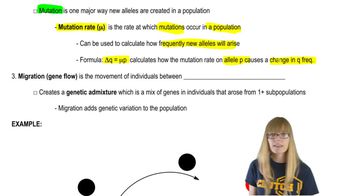
New Alleles and Migration

Gene Pool

The gene pool encompasses all the genetic information and alleles present in a population at a given time. It represents the total genetic diversity available for inheritance and is essential for understanding the potential for evolution within that population. Changes in the gene pool can occur through mechanisms such as mutation, migration, and selection.
Recommended video:
Guided course
09:09
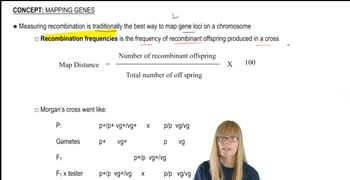
Mapping Genes

Comparison of Population and Gene Pool

While a population refers to the actual individuals and their interactions within a specific area, the gene pool is a more abstract concept that focuses on the genetic variation within that population. The two are interconnected, as the genetic makeup of a population influences its gene pool, and changes in the gene pool can affect the population's evolutionary trajectory.
Recommended video:
Guided course
09:09
Mapping Genes