
Textbook Question
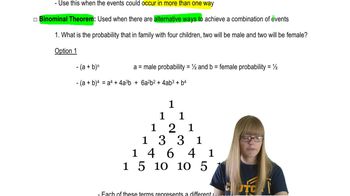
If two six-sided dice are rolled, what is the probability that the total number of spots showing is
an odd number?


 Verified step by step guidance
 07:41
07:41
 11:06
11:06 08:04
08:04If two six-sided dice are rolled, what is the probability that the total number of spots showing is
an odd number?
In pea plants, the appearance of flowers along the main stem is a dominant phenotype called 'axial' and is controlled by an allele T. The recessive phenotype, produced by an allele t, has flowers only at the end of the stem and is called 'terminal.' Pod form displays a dominant phenotype, 'inflated,' controlled by an allele C, and a recessive 'constricted' form, produced by the c allele. A cross is made between a pure-breeding axial, constricted plant and a plant that is pure-breeding terminal, inflated.
If an F₁ plant from the initial cross described above is crossed with a plant that is terminal, constricted, what is the expected distribution among the resulting progeny?
In pea plants, the appearance of flowers along the main stem is a dominant phenotype called 'axial' and is controlled by an allele T. The recessive phenotype, produced by an allele t, has flowers only at the end of the stem and is called 'terminal.' Pod form displays a dominant phenotype, 'inflated,' controlled by an allele C, and a recessive 'constricted' form, produced by the c allele. A cross is made between a pure-breeding axial, constricted plant and a plant that is pure-breeding terminal, inflated.
If the plants with terminal flowers produced by the cross in part (c) are saved and allowed to self-fertilize, what is the expected phenotypic distribution among the progeny?
If two six-sided dice are rolled, what is the probability that the total number of spots showing is 4?
If two six-sided dice are rolled, what is the probability that the total number of spots showing is
greater than 5?
Experimental Insight 2.1 describes data, collected by a genetics class like yours, on the numbers of kernels of different colors in bicolor corn. To test the hypothesis that the presence of kernels of different colors in each ear is the result of the segregation of two alleles of a single gene, the class counted 12,356 kernels and found that 9304 were yellow and 3052 were white. Use chi-square analysis to evaluate the fit between the segregation hypothesis and the class results.