You conduct a study in which the transcriptional fusion of regulatory sequences of a particular gene with a reporter gene results in relatively uniform expression of the reporter gene in all cells of an organism. A translational fusion with the same gene shows reporter gene expression only in the nucleus of a specific cell type. Discuss some biological causes for the difference in expression patterns of the two transgenes.

Sanders 3rd Edition
Ch. 14 - Analysis of Gene Function via Forward Genetics and Reverse Genetics
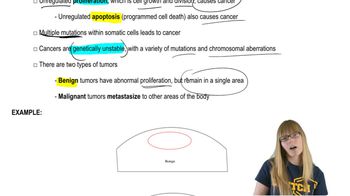
Problem C.2aA tumor is a growing mass of abnormal cells. Describe the difference between a benign tumor and a malignant tumor.
Verified step by step guidance
Verified video answer for a similar problem:
Key Concepts
Benign Tumor
Malignant Tumor
Tumor Growth and Metastasis
A tumor is a growing mass of abnormal cells. What must happen for a benign tumor to become malignant?
A tumor is a growing mass of abnormal cells. Give an example from this chapter of a benign tumor that becomes a malignant tumor.
Discuss the similarities and differences between forward and reverse genetic approaches, and when you would choose to utilize each of the approaches.
Go to the National Institute for Child Health and Human Development (http://www.nichd.nih.gov), locate the search box at the top right corner of the homepage, and enter 'RUSP' to search for information on the Recommended Uniform Screening Panel. From the options that appear, select 'Brief History of Newborn Screening' and locate the discussion listing the criteria for adding a disease to the RUSP list. What are the criteria for listing a disease on the RUSP list?
For the retinal cancer retinoblastoma, the inheritance of one mutated copy of RB1 from one of the parents is often referred to as a mutation that produces a 'dominant predisposition to cancer.' This means that the first mutation does not produce cancer but makes it very likely that cancer will develop.
Explain why cancer is almost certain to develop with the inheritance of one mutated copy of RB1.