Pearson+ LogoPearson+ Logo
Ch. 11 - Gene Mutation, DNA Repair, and Homologous Recombination
Sanders - Genetic Analysis: An Integrated Approach 3rd Edition
Sanders3rd EditionGenetic Analysis: An Integrated ApproachISBN: 9780135564172Not the one you use?Change textbook
Chapter 11, Problem 18

How are flanking direct repeat sequences created by transposition?

Verified step by step guidance
1
Understand the concept of transposition: Transposition is the movement of transposable elements (TEs) within the genome. These elements can insert themselves into new locations, often creating structural changes in the DNA sequence.
Learn about flanking direct repeats: Flanking direct repeats are short, identical sequences found on both sides of a transposable element after it inserts into the genome. These repeats are not part of the transposable element itself but are created during the insertion process.
Examine the mechanism of insertion: When a transposable element inserts into a target site, the target DNA is cleaved asymmetrically, creating single-stranded overhangs. These overhangs are complementary and will later be filled in during DNA repair.
Understand the role of DNA polymerase: After the transposable element is inserted, DNA polymerase fills in the single-stranded gaps created by the asymmetric cleavage. This process duplicates the sequence at the target site, resulting in the flanking direct repeats.
Recognize the significance of flanking direct repeats: These repeats are a hallmark of transposition and can be used to identify the presence and activity of transposable elements in the genome. They also provide insight into the molecular mechanisms of transposition.

Verified video answer for a similar problem:

This video solution was recommended by our tutors as helpful for the problem above.
Video duration:
1m
Was this helpful?

Key Concepts

Here are the essential concepts you must grasp in order to answer the question correctly.

Transposition

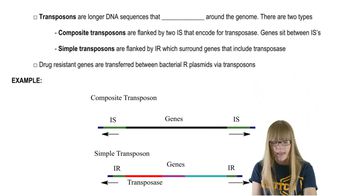
Transposition is the process by which a segment of DNA, known as a transposon or 'jumping gene', moves from one location in the genome to another. This movement can occur through a 'cut and paste' mechanism or a 'copy and paste' mechanism, leading to the insertion of the transposon at a new site. Understanding transposition is crucial for grasping how flanking direct repeat sequences are formed.
Recommended video:
Guided course
06:10
Prokaryotic Transposable Elements

Flanking Direct Repeat Sequences

Flanking direct repeat sequences are short, identical sequences of DNA that are found on either side of a transposon after it has inserted into a new location. These repeats are created during the transposition process when the transposon integrates into the target DNA, causing the host DNA to be cut and then repaired, resulting in the duplication of the adjacent sequences. This phenomenon is a hallmark of transposable elements.
Recommended video:
Guided course
08:41
Sequencing Difficulties

DNA Repair Mechanisms

DNA repair mechanisms are cellular processes that correct damage to the DNA structure. When a transposon inserts itself into a new location, the host cell's repair machinery is activated to fix the breaks in the DNA. This repair often results in the duplication of the sequences adjacent to the insertion site, leading to the formation of flanking direct repeat sequences, which are essential for understanding the impact of transposition on genomic architecture.
Recommended video:
Guided course
05:44
Repair Pathways