Back
Back
Problem 49
Use transformations of f(x)=1/x or f(x)=1/x2 to graph each rational function. g(x)=1/(x+1) − 2
Problem 49
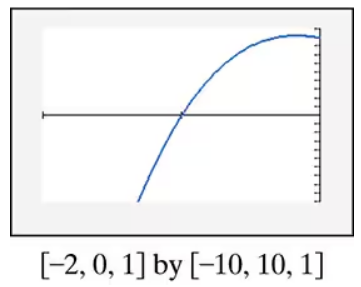
Find all zeros of the polynomial function or solve the given polynomial equation. Use the Rational Zero Theorem, Descartes's Rule of Signs, and possibly the graph of the polynomial function shown by a graphing utility as an aid in obtaining the first zero or the first root. 4x4−x3+5x2−2x−6=0
Problem 49
In Exercises 49–50, find all the zeros of each polynomial function and write the polynomial as a product of linear factors.
Problem 50
Solve each rational inequality in Exercises 43–60 and graph the solution set on a real number line. Express each solution set in interval notation. (3x+5)/(6−2x)≥0
- In Exercises 49–50, find all the zeros of each polynomial function and write the polynomial as a product of linear factors. g(x) = x^4 - 6x^3 + x^2 + 24x + 16
Problem 50
Problem 51
Find all zeros of the polynomial function or solve the given polynomial equation. Use the Rational Zero Theorem, Descartes's Rule of Signs, and possibly the graph of the polynomial function shown by a graphing utility as an aid in obtaining the first zero or the first root. 2x5+7x4−18x2−8x+8=0
Problem 51
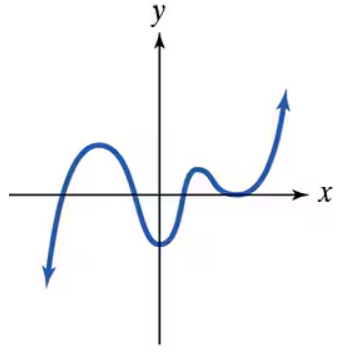
In Exercises 51–54, graphs of fifth-degree polynomial functions are shown. In each case, specify the number of real zeros and the number of imaginary zeros. Indicate whether there are any real zeros with multiplicity other than 1.
Problem 51
Use transformations of f(x)=1/x or f(x)=1/x2 to graph each rational function. g(x)=1/(x+2)2
Problem 51
Solve each rational inequality in Exercises 43–60 and graph the solution set on a real number line. Express each solution set in interval notation. x/(x−3)>0
Problem 51
Write an equation in vertex form of the parabola that has the same shape as the graph of f(x) = 2x2 but with the given point as the vertex. (−10, −5)
Problem 52
Solve each rational inequality in Exercises 43–60 and graph the solution set on a real number line. Express each solution set in interval notation. (x+4)/x>0
Problem 53
Solve each rational inequality in Exercises 43–60 and graph the solution set on a real number line. Express each solution set in interval notation. (x+4)(x−1)/(x+2)≤0
Problem 53
Use transformations of f(x)=1/x or f(x)=1/x2 to graph each rational function. h(x)=1/x2 − 4
Problem 53
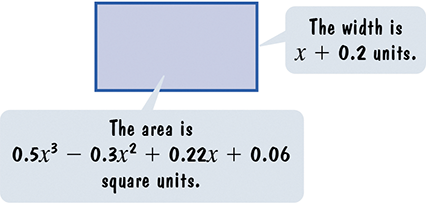
Write a polynomial that represents the length of each rectangle. Transcription: The area of the rectangle is 0.5x3 - 0.3x2 + 0.22x + 0.06 square units and its width is x + 0.2 units
Problem 53
Exercises 53–60 show incomplete graphs of given polynomial functions. a) Find all the zeros of each function. b) Without using a graphing utility, draw a complete graph of the function. f(x)=−x3+x2+16x−16
Problem 53
Write an equation in vertex form of the parabola that has the same shape as the graph of f(x) = 3x2 or g(x) = -3x2, but with the given maximum or minimum. Maximum = 4 at x = -2
Problem 55
Exercises 53–60 show incomplete graphs of given polynomial functions. a) Find all the zeros of each function. b) Without using a graphing utility, draw a complete graph of the function. f(x)=4x3−8x2−3x+9
Problem 55
Write an equation in vertex form of the parabola that has the same shape as the graph of f(x) = 3x2 or g(x) = -3x2, but with the given maximum or minimum. Minimum = 0 at x = 11
Problem 55
Solve each rational inequality in Exercises 43–60 and graph the solution set on a real number line. Express each solution set in interval notation. (x + 1)/(x + 3) < 2
Problem 55
Use transformations of f(x)=1/x or f(x)=1/x2 to graph each rational function. h(x)=1/(x−3)2+1
Problem 55
Use transformations of f(x) = (1/x) or f(x) = (1/x2) to graph each rational function. g(x) = 1/(x + 2)2 - 1
Problem 57
Follow the seven steps to graph each rational function. f(x)=4x/(x−2)
Problem 57
In Exercises 57–64, find the vertical asymptotes, if any, the horizontal asymptote, if one exists, and the slant asymptote, if there is one, of the graph of each rational function. Then graph the rational function. f(x) = 2x/(x^2 - 9)
Problem 57
Exercises 53–60 show incomplete graphs of given polynomial functions. a) Find all the zeros of each function. b) Without using a graphing utility, draw a complete graph of the function. f(x)=2x4−3x3−7x2−8x+6
Problem 57
Solve each rational inequality in Exercises 43–60 and graph the solution set on a real number line. Express each solution set in interval notation. (x + 4)/(2x - 1) ≤ 3
Problem 58
In Exercises 57–64, find the vertical asymptotes, if any, the horizontal asymptote, if one exists, and the slant asymptote, if there is one, of the graph of each rational function. Then graph the rational function. g(x) = (2x - 4)/(x + 3)
Problem 58
Solve each rational inequality in Exercises 43–60 and graph the solution set on a real number line. Express each solution set in interval notation.1/(x - 3) < 1
Problem 59
In Exercises 57–64, find the vertical asymptotes, if any, the horizontal asymptote, if one exists, and the slant asymptote, if there is one, of the graph of each rational function. Then graph the rational function. h(x) = (x^2 - 3x - 4)/(x^2 - x -6)
Problem 59
Solve:
Problem 59
Solve each rational inequality in Exercises 43–60 and graph the solution set on a real number line. Express each solution set in interval notation. (x - 2)/(x + 2) ≤ 2