Explain the relationship between electron transport and oxidative phosphorylation. How do uncoupling proteins 'uncouple' this relationship in brown adipose tissue?
Ch. 9 - Cellular Respiration and Fermentation
Chapter 9, Problem 10
Early estimates suggested that the oxidation of glucose via aerobic respiration would produce 38 ATP. Based on what you know of the theoretical yields of ATP from cellular respiration, show how this total was determined. Why do biologists now think this amount of ATP per molecule of glucose is not achieved in cells?
Verified step by step guidance1
Step 1: Understand the stages of cellular respiration. Cellular respiration consists of glycolysis, the Krebs cycle, and oxidative phosphorylation (including the electron transport chain). Each stage contributes to ATP production.
Step 2: Calculate ATP from glycolysis. Glycolysis converts one glucose molecule into two pyruvate molecules, producing a net gain of 2 ATP and 2 NADH. The 2 NADH can potentially produce 6 ATP via oxidative phosphorylation (assuming 3 ATP per NADH).
Step 3: Calculate ATP from the Krebs cycle. Each acetyl-CoA entering the Krebs cycle generates 1 ATP (or GTP), 3 NADH, and 1 FADH2. Since two acetyl-CoA molecules are produced from one glucose, this results in 2 ATP, 6 NADH, and 2 FADH2. The 6 NADH can produce 18 ATP and the 2 FADH2 can produce 4 ATP via oxidative phosphorylation.
Step 4: Sum the ATP totals. Adding the ATP from glycolysis (2 ATP + 6 ATP from NADH), the Krebs cycle (2 ATP + 18 ATP from NADH + 4 ATP from FADH2), and the ATP directly produced from oxidative phosphorylation of the NADH and FADH2 generated in these processes, the theoretical maximum yield would be 38 ATP (2+6+2+18+4+6 from oxidative phosphorylation of the NADH from glycolysis).
Step 5: Understand why actual ATP yield is lower. Biologists now recognize that the theoretical maximum is seldom reached due to losses like the cost of transporting pyruvate into mitochondria, and the use of the proton gradient for purposes other than ATP synthesis (like heat production and transport of other ions). Additionally, the ratio of ATP per NADH and FADH2 can vary depending on the cell type and conditions, often being lower than the theoretical 3 and 2, respectively.

Verified video answer for a similar problem:
This video solution was recommended by our tutors as helpful for the problem above.
Video duration:
5mWas this helpful?
Key Concepts
Here are the essential concepts you must grasp in order to answer the question correctly.
Aerobic Respiration
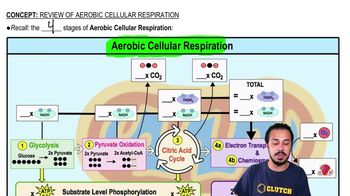
Aerobic respiration is a metabolic process in which cells convert glucose and oxygen into energy, carbon dioxide, and water. This process occurs in several stages, including glycolysis, the Krebs cycle, and the electron transport chain, ultimately leading to the production of ATP, the energy currency of the cell. The theoretical maximum yield of ATP from one glucose molecule is often cited as 38 ATP, based on the complete oxidation of glucose.
Recommended video:
Guided course
Review of Aerobic Cellular Respiration
ATP Yield Calculation
The calculation of ATP yield from glucose involves understanding the energy produced at each stage of cellular respiration. Glycolysis produces 2 ATP, the Krebs cycle generates 2 ATP, and the electron transport chain can produce up to 34 ATP through oxidative phosphorylation. However, the actual yield can vary due to factors such as proton leakage and the use of the proton gradient for other cellular processes, which can lower the total ATP produced.
Recommended video:
Realistic ATP Production
Biologists now believe that the theoretical yield of 38 ATP is rarely achieved in living cells due to inefficiencies in the process. Factors such as the use of the proton motive force for purposes other than ATP synthesis, the cost of transporting ATP out of mitochondria, and the energy required for cellular maintenance contribute to a lower actual yield, often estimated to be around 30-32 ATP per glucose molecule in eukaryotic cells.
Recommended video:
Related Practice
Textbook Question
Textbook Question
The researchers who observed that magnetite was produced by bacterial cultures from the deep subsurface carried out a follow-up experiment. These biologists treated some of the cultures with a drug that poisons the enzymes involved in electron transport chains. In cultures where the drug was present, no more magnetite was produced. Does this result support or undermine their hypothesis that the bacteria in the cultures perform cellular respiration? Explain your reasoning.
Textbook Question
Cyanide (C ≡ N−) blocks complex IV of the electron transport chain. Suggest a hypothesis for what happens to the ETC when complex IV stops working. Your hypothesis should explain why cyanide poisoning in humans is fatal.
