


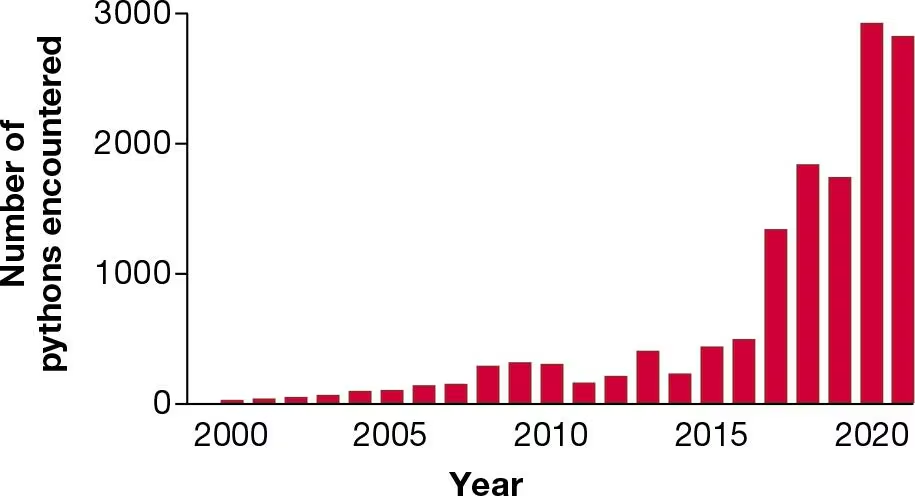
Burmese pythons (Python molurus bivittatus) are constricting snakes that can reach enormous sizes (up to 7 meters in length). They are native to Southeast Asia but were released into southern Florida from the pet trade. Many other snakes occur naturally in this area. Are the introduced pythons a problem? Burmese pythons were first found in the wetlands of Everglades National Park in the 1980s, but only rarely. The accompanying graph shows what happened next. Most of the data are derived from chance encounters of pythons on roads and intermittent search effort near roads (pythons are notoriously difficult to find). Despite the variability in search effort, what type of population growth best describes the trend in the data from 2000 to 2020? a. logistic b. exponential c. linear d. logarithmic

- Ch. 1 - Biology: The Study of Life13
- Ch. 2 - Water and Carbon: The Chemical Basis of Life14
- Ch.3 - Protein Structure and Function10
- Ch.4 - Nucleic Acids and the RNA World10
- Ch. 5 - An Introduction to Carbohydrates10
- Ch. 6 - Lipids, Membranes, and the First Cells11
- Ch. 7 - Inside the Cell10
- Ch. 8 - Energy and Enzymes: An Introduction to Metabolism10
- Ch. 9 - Cellular Respiration and Fermentation11
- Ch. 10 - Photosynthesis12
- Ch. 11 - Cell-Cell Interactions12
- Ch. 12 - The Cell Cycle8
- Ch. 13 - Meiosis12
- Ch. 14 - Mendel and the Gene23
- Ch. 15 - DNA and the Gene: Synthesis and Repair15
- Ch. 16 - How Genes Work16
- Ch. 17 - Transcription, RNA Processing, and Translation16
- Ch. 18 - Control of Gene Expression in Bacteria16
- Ch. 19 - Control of Gene Expression in Eukaryotes12
- Ch. 20 - The Molecular Revolution: Biotechnology, Genomics, and New Frontiers15
- Ch. 21 - Genes, Development, and Evolution12
- Ch. 22 - Evolution by Natural Selection16
- Ch. 23 - Evolutionary Processes13
- Ch. 24 - Speciation15
- Ch. 25 - Phylogenies and the History of Life13
- Ch. 26 - Bacteria and Archaea15
- Ch. 27 - Diversification of Eukaryotes16
- Ch. 28 - Green Algae and Land Plants16
- Ch. 29 - Fungi18
- Ch. 30 - An Introduction to Animals9
- Ch. 31 - Protostome Animals15
- Ch. 32 - Deuterostome Animals17
- Ch. 33 - Viruses16
- Ch. 34 - Plant Form and Function16
- Ch. 35 - Water and Sugar Transport in Plants16
- Ch. 36 - Plant Nutrition13
- Ch. 37 - Plant Sensory Systems, Signals, and Responses16
- Ch. 38 - Flowering Plant Reproduction and Development16
- Ch. 39 - Animal Form and Function17
- Ch. 40 - Water and Electrolyte Balance in Animals16
- Ch. 41 - Animal Nutrition16
- Ch. 42 - Gas Exchange and Circulation16
- Ch. 43 - Animal Nervous Systems16
- Ch. 44 - Animal Sensory Systems16
- Ch. 45 - Animal Movement11
- Ch. 46 - Chemical Signals in Animals16
- Ch. 47 - Animal Reproduction and Development16
- Ch. 48 - The Immune System in Animals16
- Ch. 49 - An Introduction to Ecology15
- Ch. 50 - Behavioral Ecology16
- Ch. 51 - Population Ecology16
- Ch. 52 - Community Ecology20
- Ch. 53 - Ecosystems and Global Ecology17
- Ch. 54 - Biodiversity and Conservation Ecology18
<Image>
Burmese pythons (Python molurus bivittatus) are constricting snakes that can reach enormous sizes (up to 7 meters in length). They are native to Southeast Asia but were released into southern Florida from the pet trade. Many other snakes occur naturally in this area. Are the introduced pythons a problem?
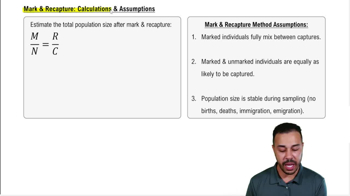
The data in the graph show the number of pythons that were encountered, not the total number of pythons in the population. Design a mark–recapture experiment to estimate the total population size of pythons, and list at least two assumptions you would be making in your experiment.
 Verified step by step guidance
Verified video answer for a similar problem:

Key Concepts
Mark-Recapture Method
 02:10
02:10
Assumptions in Mark-Recapture
02:10Ecological Impact of Invasive Species
 01:56
01:56<Image>
Burmese pythons (Python molurus bivittatus) are constricting snakes that can reach enormous sizes (up to 7 meters in length). They are native to Southeast Asia but were released into southern Florida from the pet trade. Many other snakes occur naturally in this area. Are the introduced pythons a problem?
Researchers hypothesize that the severe winter of 2010 caused the decline in the number of pythons encountered that year. Is cold weather typically a density-dependent factor or a density-independent factor? Explain the difference.
<Image>
Burmese pythons (Python molurus bivittatus) are constricting snakes that can reach enormous sizes (up to 7 meters in length). They are native to Southeast Asia but were released into southern Florida from the pet trade. Many other snakes occur naturally in this area. Are the introduced pythons a problem?
A life table would help researchers make predictions about python population growth. If you were to track a cohort of pythons over time to construct a detailed life table, what kind of data would you want to collect?
Burmese pythons (Python molurus bivittatus) are constricting snakes that can reach enormous sizes (up to 7 meters in length). They are native to Southeast Asia but were released into southern Florida from the pet trade. Many other snakes occur naturally in this area. Are the introduced pythons a problem? Pythons are generalist predators, consuming more than 75 species of prey including frogs, mice, rabbits, squirrels, porcupines, raccoons, leopards, deer, monkeys, alligators, and birds ranging from wrens to herons. Some surveys showed the disappearance of some animals, such as rabbits and opossums, from areas with pythons. Do you think food availability limits, or could limit, the carrying capacity of Burmese pythons in the Everglades?
<Image>
Burmese pythons (Python molurus bivittatus) are constricting snakes that can reach enormous sizes (up to 7 meters in length). They are native to Southeast Asia but were released into southern Florida from the pet trade. Many other snakes occur naturally in this area. Are the introduced pythons a problem?
The range of Burmese pythons in Florida is expanding rapidly. List at least one abiotic factor and one biotic factor that might limit the range of pythons.